



Your guide to the best eSIM for Asia
Traveling through Asia often means relying on your phone for much more than just keeping in touch with friends and family back home. You might need to use Google Maps to find your hotel in Tokyo, a translation app to order dinner in Seoul, Grab to book a ride in Bangkok, or WhatsApp to message your hotel in Vietnam. Train and transit tickets, flight updates, restaurant bookings, and last-minute travel arrangements can all depend on having mobile internet. And if your itinerary covers several countries, buying a new local SIM card every time you cross a border might quickly become inconvenient. An eSIM offers an alternative to international roaming and physical SIM cards, with service providers such as Saily offering regional plans designed for travel across Asia.

Table of Contents
- Why is an eSIM worth it for Asia?
- What should you look for in an eSIM for Asia?
- Which countries does an Asia eSIM cover?
- What kind of trips is an Asia eSIM good for?
- Backpacking through Southeast Asia
- Multi-country tours
- City breaks and short vacations
- Digital nomads and remote work
- How much data do you need in Asia — and what does an eSIM cost?
- How to activate an eSIM for Asia
- Why many travelers choose a regional eSIM over local SIM cards
- Our recommendation: What’s the best eSIM for Asia?
Why is an eSIM worth it for Asia?
An eSIM can make traveling in Asia considerably easier, particularly when your trip involves more than one country. Instead of hunting for a local SIM card or standing in airport queues each time you land — where prices are often higher than elsewhere — you can buy and install one travel eSIM, such as Saily, before departure and connect to a supported mobile network the moment you land. That means using maps, booking transport, or messaging on WhatsApp right away, without wasting time trying to get online.
It also eliminates the hassle of swapping tiny physical cards in and out of your phone — and the risk of misplacing your regular one along the way.
The benefits become even more noticeable on multi-stop itineraries. Backpackers traveling through Southeast Asia, digital nomads moving between cities, and long-term travelers island hopping around the region may cross several borders in a matter of weeks. With a regional eSIM, you stay connected during border crossings and don’t need to buy, register, and set up a new mobile plan in each country.
International roaming from US carriers such as AT&T, T-Mobile, and Verizon can be convenient, but daily international charges add up fast on a longer trip.
For a trip covering several destinations, it therefore makes sense to look for a regional eSIM plan rather than separate country plans. Saily’s eSIM for Asia and Oceania covers 22 countries, making it particularly useful for multi-country tours, backpacking, island hopping, and longer trips.
What should you look for in an eSIM for Asia?
Asia eSIM plans vary considerably in coverage, data allowance, validity, and price. Many eSIM service providers, including Saily, Airalo, and Holafly, offer regional plans for Asia. Rather than choosing purely by brand or picking whichever plan has the lowest headline price, compare what you’re actually getting for your trip. Also, make sure your phone supports eSIM technology and is carrier unlocked.
Things to check before buying:
Country coverage. Start with your itinerary. You may, at first glance, think an eSIM for Asia is a comprehensive solution for all of the countries in the region, but providers don’t all include the same destinations. Check every country you plan to visit against the offers, including any stopovers where you may need mobile data too.
Data allowance. A few gigabytes may be plenty for maps, messaging, and occasional browsing on a short vacation. But regular video streaming, social media, video calls, or remote work use considerably more data, so it’s worth estimating your needs honestly before choosing a plan. Beyond the data amount itself, also check for any speed restrictions that may kick in after you reach a certain level of usage.
Plan validity. Check not just how long the plan lasts, but when the countdown to expiration starts — some plans activate on installation, and others on first connection, which matters if you’re buying ahead of your trip.
Hotspot support. If you’re planning to work remotely or connect multiple devices, check whether the provider supports hotspot use and whether any limits apply.
Activation and app experience. Installing and managing an eSIM shouldn’t become another travel headache. App-based installation and plan management will make setup, top-ups, and troubleshooting easier while you’re away.
Value for money. Compare the amount of data, validity period, and country coverage rather than looking at price alone. A cheaper plan isn’t much of a bargain if it doesn’t cover half your itinerary.
Customer support. Connectivity problems are inconvenient anywhere, but they’re particularly frustrating when you’ve just arrived somewhere unfamiliar. Check what support the provider offers and when it’s available.
If you’re new to travel eSIMs, it also helps to understand what contributes to reliable internet while traveling before choosing a plan.
For many travelers, the best eSIM for Asia isn’t necessarily the cheapest. It’s the one that offers the right combination of coverage, data, validity, flexibility, and straightforward setup. Saily is one example of a service designed with multi-country travel in mind, but the right choice ultimately depends on where you’re going and how you use your phone.
Which countries does an Asia eSIM cover?
Coverage can vary considerably between Asian eSIM service providers, so don’t assume that a plan labeled “Asia” will work everywhere on the continent. This is especially important if your itinerary combines destinations in Southeast, East, Central, or South Asia.
As of October 2026, Saily’s Asia and Oceania regional eSIM covers 22 countries:
Australia
Bangladesh
Cambodia
China
Hong Kong
India
Indonesia
Japan
Kazakhstan
Laos
Macau
Malaysia
New Zealand
Pakistan
Philippines
Singapore
South Korea
Sri Lanka
Taiwan
Thailand
Uzbekistan
Vietnam
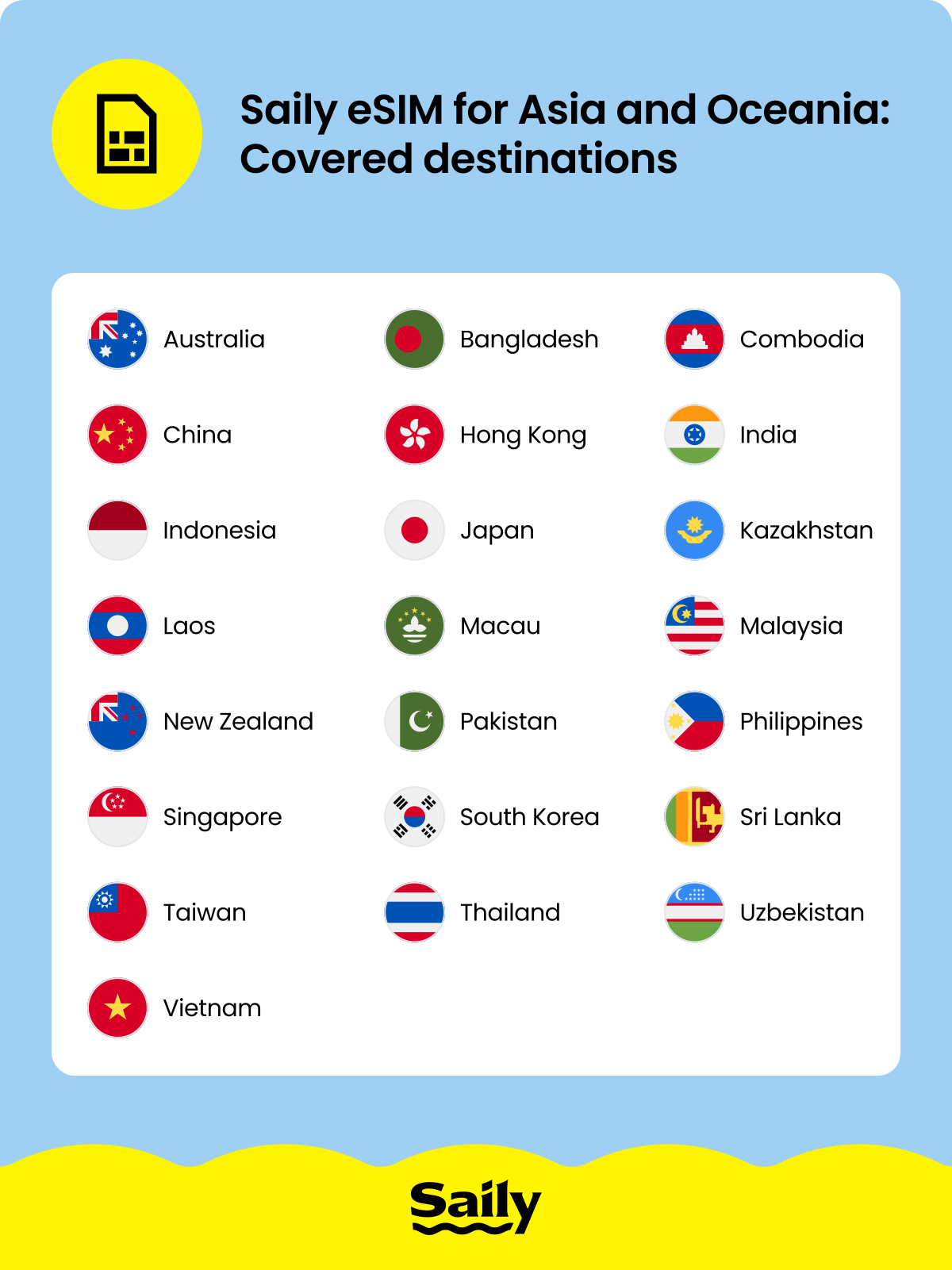
So with the Saily eSIM, a backpacker could travel from Thailand through Cambodia and Vietnam without buying a different SIM in each country, while a business traveler could transit between Singapore, Hong Kong, and South Korea using the same data plan.
Saily’s eSIM for Asia and Oceania is also useful for digital nomads who change locations regularly and travelers combining Asia with Australia or New Zealand.
That said, whatever provider you choose, check the current country list before purchasing because regional coverage can change.
Need data in Asia? Get an eSIM!

1 GB
7 days
US$4.993 GB
30 days
US$12.495 GB
30 days
US$19.49
What kind of trips is an Asia eSIM good for?
The main advantage of a regional eSIM is flexibility. Whether your trip spans ten countries or just two, one installed plan covers you — no need to arrange separate mobile service in every destination.
Backpacking through Southeast Asia
Southeast Asia is a natural fit for regional eSIMs, since many popular backpacking routes cross several countries — you might start in Thailand, continue through Cambodia, and then spend several weeks exploring Vietnam.
Relying on separate local SIM cards means that every border crossing involves finding another provider, buying another plan, and changing your mobile setup. A regional eSIM removes much of that repetition, connecting to supported networks automatically as you move between destinations.
So when choosing an eSIM for Southeast Asia, don’t just compare data allowances — broad regional coverage, sensible validity periods, and straightforward network switching will shape your trip far more.
Multi-country tours
Regional plans also work well for shorter trips combining several major destinations. Japan, South Korea, and Taiwan can make one itinerary, while Singapore, Malaysia, and Indonesia are another common combination.
Instead of arranging connectivity separately at every stop, one eSIM can cover your trip if all the destinations appear on the provider’s regional plan.
A Global eSIM may make more sense if Asia forms only part of a much larger trip, perhaps with onward travel to Europe or North America or several international stopovers. Compare the country coverage and data allowance against your complete itinerary before deciding.
City breaks and short vacations
An eSIM can be useful even if you’re only visiting one Asian city for a few days. You can set it up before departure and have internet access soon after landing, rather than spending the beginning of your vacation comparing SIM cards at the airport.
That convenience matters when you need directions, a ride to your hotel, a translation app, or access to a digital booking confirmation immediately.
For a short trip, however, you may not need a large regional package. Compare regional and country-specific eSIM plans to see which better matches your destination, length of stay, and expected usage.
Digital nomads and remote work
Remote workers generally need more from an eSIM plan than vacationers. Maps and messaging use relatively little data, but video meetings, cloud-based work, file transfers, and laptop tethering can consume much more.
Digital nomads should therefore pay particular attention to data allowance, plan validity, network coverage, and hotspot support. Saily’s Asia and Oceania regional plans support hotspot sharing, which can be useful if your accommodation Wi-Fi is slow or unreliable.
A regional eSIM can also provide a useful backup connection when you’re working while traveling. Hotel and coworking Wi-Fi may cover most of your needs, but mobile data gives you another option when you can’t get online — and a safer one because public networks make it easier for attackers to intercept your traffic. For sensitive tasks like online banking or entering personal details, your own mobile connection is often the safer choice.
How much data do you need in Asia — and what does an eSIM cost?
How much data you’ll need depends on the length of your trip, where you’re going, and what you do online. Travelers often overestimate their mobile data use here, forgetting that streaming, video calls, and big downloads tend to happen over hotel, hostel, café, or coworking Wi-Fi.
Saily currently offers the following Asia and Oceania regional plans:
Data | Validity | Plan |
|---|---|---|
1 GB | 7 days | US$4.99 |
3 GB | 30 days | US$12.49 |
5 GB | 30 days | US$19.49 |
10 GB | 30 days | US$35.99 |
25 GB | 60 days | US$48.99 |
Unlimited | Varies by selected duration | From US$54.99 |
Prices and plan availability can change, so check the current options before purchasing. An unlimited plan may suit heavy users, but unlimited data plans can have fair-use conditions or speed restrictions, so check the details before choosing one.
Navigation and messaging don’t usually require huge amounts of data. Standard navigation may use only around 5-10 MB per hour, while text-based messaging through apps such as WhatsApp generally uses very little.
Social media apps such as Instagram and TikTok can use around 100-300 MB per hour, depending on what you watch and your settings. HD video streaming is much more data-intensive and can use around 1-3 GB per hour. Video calls and using your phone as a hotspot for a laptop can also use up your data allowance quickly.
For many travelers spending one or two weeks in Asia, around 5-10 GB should comfortably cover everyday activities such as maps, messaging, browsing, bookings, and moderate social media use for the entire trip, particularly if Wi-Fi is available at their accommodation. Heavy social media users, digital nomads, frequent streamers, and remote workers may need considerably more.
If you’re unsure where you fall on that scale, Saily’s data usage calculator can give you a personalized estimate based on your typical online activities.
How to activate an eSIM for Asia
Setting up an Asia eSIM is usually straightforward, and it’s worth doing before you leave home while you have a stable internet connection. The exact process varies slightly between providers and devices, but it generally looks like this:
Buy your eSIM plan. Choose a regional or country plan that covers your destinations and expected data usage.
Add the eSIM to your phone. Depending on the provider, you may scan a QR code or install it through an app. With Saily, you can manage the process through the Saily eSIM app.
Install the eSIM. Follow the on-screen instructions and make sure you don’t delete the eSIM after installation.
Enable roaming for the travel eSIM. You’ll normally need to turn on data roaming for the eSIM line so it can connect to supported partner networks abroad.
Connect when you arrive. Select the eSIM for cellular data once you arrive. If you’re in a supported destination, it should then connect to an available local network.
If this is your first time using one, it may help to read more about what an eSIM is and how it works before installation.
With Saily, you can install the eSIM before your trip, and the regional plan activates when you arrive at your first supported destination, provided the Saily eSIM is enabled and roaming is turned on for that line. Setting up your eSIM in advance means you don’t have to depend on airport Wi-Fi to get connected after a long flight.
Why many travelers choose a regional eSIM over local SIM cards
Local SIM cards can still be a good option, particularly if you’re spending several weeks or months in one country. They may be less convenient when you’re traveling from country to country.
Buying a SIM card after every border crossing takes time. You may need to find an authorized retailer, compare packages, deal with a foreign language, and provide identification for SIM registration. Getting a SIM card at the airport can cut out some steps, but that convenience may come at a higher price.
Switching local SIM cards can also mean changing phone numbers along the way, which gets annoying when you’re using your number for messages, bookings, or travel updates.
Physical SIM cards also come with a practical hassle — keeping track of them. Your home SIM has to be stored in a safe place so you won’t lose it, as do any local ones you’ve picked up along the way, and it’s easy to misplace one while you’re traveling. A regional eSIM eliminates much of that friction. Setup is digital, the eSIM is installed on your device, and a compatible regional plan connects automatically across several destinations. You can also keep your primary SIM in your phone, which makes it easier to retain access to your home number when needed.
For cross-border travel, Saily is one option that combines regional coverage with app-based installation and a choice of data allowances. The main benefit is convenience — fewer steps to set up your phone and less time thinking about connectivity while you’re traveling.
Our recommendation: What’s the best eSIM for Asia?
No single provider is the best eSIM for Asia travel in every situation. Someone spending a week in Tokyo has very different needs from a backpacker traveling across Southeast Asia for two months or a digital nomad working from several countries.
Before choosing, consider how many countries you’ll visit, how long you’ll be away, how much mobile data you’re likely to use, and whether your priority is price, flexibility, or convenience.
For multi-country trips, the most useful Asia eSIM will generally offer broad coverage, straightforward activation, reliable connectivity through local partner networks, transparent pricing, and enough choice in data packages to avoid paying for far more data than you need.
On that basis, Saily is one of the more practical options for a multi-country Asia trip. Its Asia and Oceania plan currently covers 22 countries, offers fixed-data and unlimited options, supports hotspot sharing, and can be installed before departure.
Airalo and Holafly are also established Asia eSIM providers and may suit particular itineraries or data requirements. Other eSIM providers may be a better fit for travelers with different coverage or data needs.
The best eSIM for Asia travel is the one that keeps you connected without adding another thing to worry about.

Stay connected with the Saily eSIM app
Affordable mobile data plans for every journey.
We do our best to keep everything accurate and up to date, but eSIM service provider prices, plans, and features can change quickly. If you spot something that seems outdated or incorrect, feel free to get in touch with us at [email protected] — we’d really appreciate the heads-up!
FAQ
For multi-country travel, a regional eSIM can be more convenient than an international physical SIM card because you don’t need to swap cards between destinations. Look for a plan that covers every country on your itinerary, offers enough data for your trip, and remains valid for the full travel period.
The best eSIM for international travel depends on your destinations, trip length, and data needs. For a trip focused on Asia, a regional Asia eSIM will often provide a better match than a global plan. If you’re visiting several continents, compare global eSIM options instead.
Several providers offer unlimited or high-data eSIM options for parts of Asia. Saily currently offers an unlimited option for its Asia and Oceania regional plan, alongside fixed packages from 1 GB to 25 GB. Check the current plan duration, pricing, and any applicable usage conditions before purchasing.
A regional Asia eSIM that includes both countries is usually the simplest option for a Thailand and Japan trip. Saily’s Asia and Oceania regional plan currently covers both Thailand and Japan, so you can use one installed eSIM across the two destinations rather than buying separate plans.
Yes. Regional Asia eSIMs are specifically designed to cover multiple countries on one plan. Saily’s Asia and Oceania eSIM currently covers 22 destinations, including Japan, Thailand, Vietnam, Indonesia, Singapore, South Korea, China, and India.
Around 5-10 GB is likely to be enough for many travelers taking a one- or two-week trip if they mainly use mobile data for maps, messaging, browsing, bookings, and moderate social media use. Streaming, video calls, hotspot use, and remote work can increase data consumption considerably.
A regional eSIM is usually more convenient for multi-country travel because you can keep the same eSIM installed while moving between supported destinations. A local SIM may still be cheaper or more suitable if you’re staying in one country for an extended period.
Some regional plans do. Saily’s Asia and Oceania eSIM currently includes both Australia and New Zealand as part of its 22-country coverage, making it suitable for itineraries that combine Asian destinations with Oceania.

Always connected, always on course
Connect instantly with a Saily eSIM and enjoy effortless internet access.

Related articles