


The 15 best places to study abroad: Which countries are best for US students?
How many people do you know who talk about their semester abroad like it was the defining chapter of their 20s? An entire semester of exploring an unfamiliar city that slowly starts to feel like home, making lifelong memories, networking with potential future colleagues and employers, and securing couches to crash on in the future. The only question is — what’s the best country to study abroad in? We’ll cover 15 of the best places to study abroad for US students, drawn from an Open Doors Data report from 2024, Times Higher Education’s world university rankings, and online student feedback.

Table of Contents
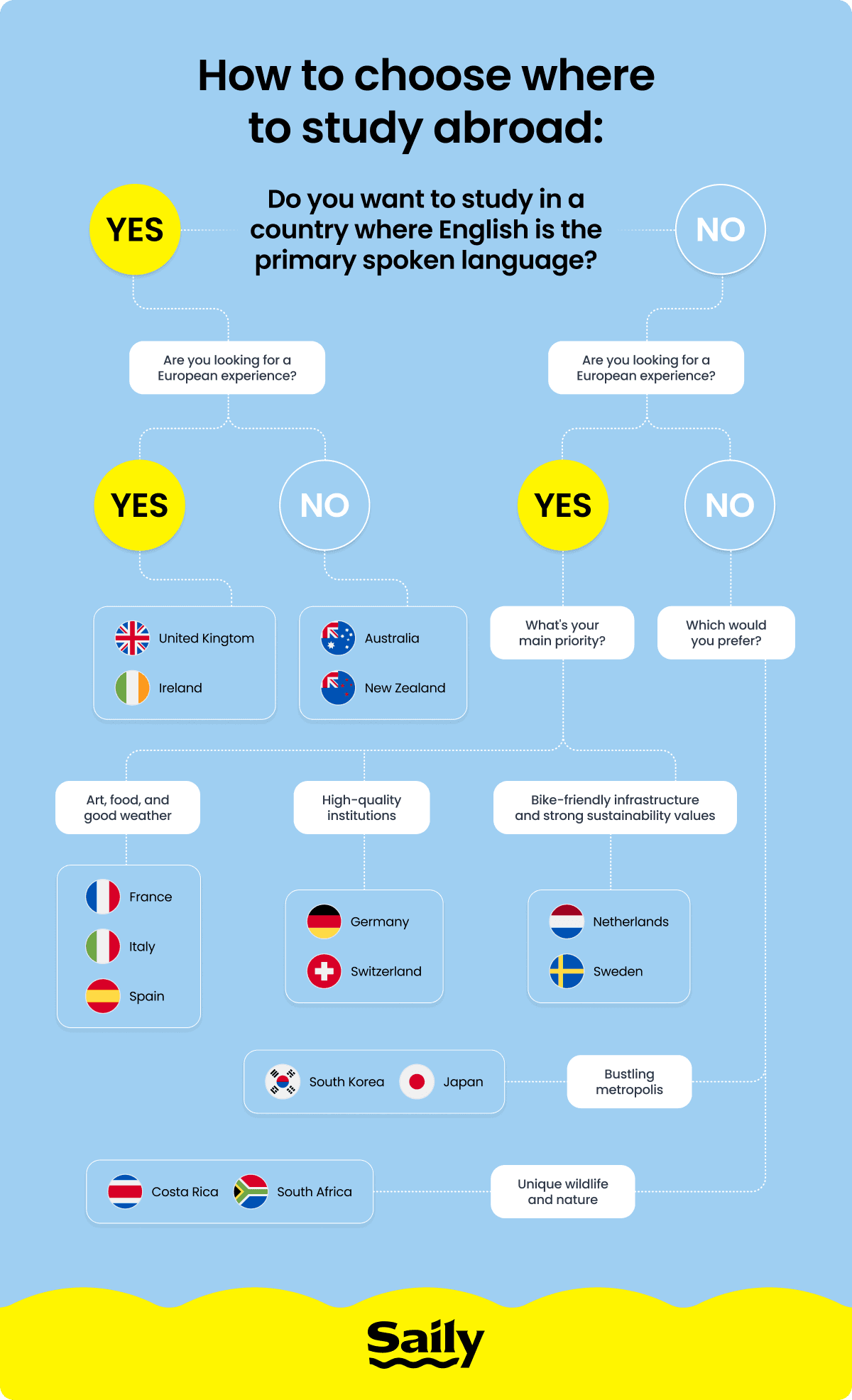
How to choose where to study abroad
Narrowing down where to study abroad depends on a few factors. In many cases, American universities have partnerships with institutions around the world, where students can take one semester or an entire academic year abroad to gain credits toward their degrees. Study abroad opportunities are most common for undergraduate programs but some graduate programs also offer them. Some important factors to consider when choosing where to study abroad include:
What fields or programs your country of interest specializes in. Some countries are best known for engineering and data science while others focus more on humanities and arts.
Education quality. Look into world university rankings and program accreditation.
Program language. Some study abroad programs offer classes in English, while others require you to pass a language test to learn in the local language.
Cost of living and tuition. Low tuition doesn’t mean low cost of living. Factor in rent, transportation, and food. If you manage to get a stipend or scholarship, even better!
Weather. Four hours of daylight in winter is a dealbreaker for many. Consider the season you’ll be studying in and whether you’ll be happy with the weather.
Safety. Check government travel advisories and read what international students actually say about day-to-day life in your destination country or city.
Online and peer recommendations. Talk to people who’ve done study abroad programs and check online forums like Reddit to read about students’ experiences.
What you hope to learn. Are you drawn to a particular country because you’re fascinated by its history? Are you hoping to pick up the language? Do you want to form a network in this country for future academic or professional endeavors? Ask yourself what kind of study abroad experience you’re hoping for.
1. France

France is easily one of the best places to study abroad for Americans, especially those looking to polish their French speaking skills. Aside from hosting prestigious institutions, France is a bucket-list destination for many thanks to its quaint vineyards, the lavender fields of the south, cozy seaside towns, and of course, Paris — the romantic City of Lights. If you need more inspiration, check out our article on fun facts about France.
Highest-ranking universities: Paris Sciences et Lettres (PSL), Institut Polytechnique de Paris, Université Paris-Saclay, Sorbonne Université.
Institution with most international students: Polytechnique de Paris (43%).
Best for programs in: Engineering, business, fashion, art, design.
Pros: Exceptional food and art scenes, diverse and photogenic landscapes, fashion-focused, strong university system, a great home base for more European travel.
Cons: Famously complicated bureaucracy, strong language barriers if you have no knowledge of French, Paris can be pricey.
2. Italy

Italy is the most popular study abroad destination for US students and it’s plain as day why. The food in Italy is famously excellent, the people are warm and inviting, and the country is essentially an open-air art and history museum. Iconic landmarks are everywhere — the Roman Forum, the Colosseum, the Leaning Tower of Pisa, the canals of Venice. Not to mention, the Università di Bologna is the oldest university in the Western world, founded in 1088.
Highest-ranking universities: University of Bologna, Scuola Normale Superiore di Pisa, Sapienza University of Rome.
Institutions with most international students: Rome Business School (71%), Politecnico di Milano (23%).
Best for programs in: Fashion, engineering, architecture, arts, humanities.
Pros: Divine food, iconic art, history, and architecture institutions, welcoming locals, vibrant student culture.
Cons: Chaotic bureaucracy, Rome and Florence are expensive, public transport varies significantly by region.

Affordable eSIM data for your semester in Europe
Say goodbye to roaming fees and laggy public Wi-Fi. Stay online with a Saily eSIM for Europe!
3. Germany

Several German universities rank in the top 100 spots for the best universities in the world. If you’re keen on pursuing business, engineering, or computer science, Germany is a great place to do your study abroad program. Berlin has become one of Europe's top cities for start-ups and of course, its nightlife is internationally renowned. Tuition at many German public universities is minimal or even free for international students, making cities like Munich, Hamburg, and Cologne highly concentrated with international students.
Highest ranking universities: Technical University of Munich, LMU Munich, Universität Heidelberg, Humboldt University of Berlin, Charité - Universitätsmedizin Berlin, RWTH Aachen University, University of Bonn, University of Tübingen.
Institutions with most international students: Constructor University (90%), TU Bergakademie Freiberg (55%), Technical University of Munich (45%).
Best for programs in: Business/management, engineering, computer science, natural sciences.
Pros: High-quality education, low tuition costs, thriving start-up scene, centrally located in Europe.
Cons: Frustrating and slow paper-only bureaucracy, somewhat unreliable train systems (expect delays and cancellations), accommodations can be costly in big cities.
4. Switzerland

Is Switzerland the most picturesque country in Europe? For many, the answer is yes — screensaver-worthy views of the Alps are ample throughout the country. Zurich, Bern, and Lausanne each have their own character. ETH Zurich currently ranks as the 11th best university in the world according to Times Higher Education, and outdoor activities like hiking and skiing are practically a way of life. Consider studying in Switzerland if you’re pursuing engineering, physics, or data science especially.
Highest ranking universities: ETH Zurich, École Polytechnique Fédérale de Lausanne, University of Bern.
Institutions with most international students: SBS Business School (77%), Università della Svizzera italiana (70%), École Polytechnique Fédérale de Lausanne (64%), ETH Zurich (44%).
Best for programs in: Engineering, computer science, data science, hospitality management, physics, earth sciences, dentistry, finance.
Pros: Stunning natural landscapes, multilingual culture, strong sustainability values, world-class universities.
Cons: One of the most expensive countries in the world, making it only doable with an incredibly tight budget or generous scholarship.
5. The Netherlands

Say goodbye to annoying traffic jams and hello to bike lanes. Dutch cities are built for people, not cars, and its urban planning is partly why the country ranks among the happiest in the world. Dutch universities aren’t just known for engineering and business like many of their European counterparts but also have a heavy focus on political science, international law, and international relations. On top of that, many university programs are taught entirely in English.
Highest ranking universities: Delft University of Technology, University of Amsterdam, Wageningen University & Research, Leiden University, University of Groningen.
Institutions with most international students: Maastricht University (60%), University of Twente (43%), University of Amsterdam (39%).
Best for programs in: Engineering, business, economics, social sciences, international law, international relations.
Pros: Bike- and pedestrian-friendly infrastructure, internationally-minded culture, locals have a strong proficiency in English, good location for European travel.
Cons: Costs of living are significant — particularly in Amsterdam.
6. Sweden

Sweden is a great country to do your study abroad program in if you’re interested in environmental science or forestry, though its many prestigious universities have many other programs to offer. Sweden is more than meatballs and IKEA — the country offers stunning natural landscapes, clean and colorful cities, and a great quality of life. Stockholm is the obvious hub, but Uppsala and Lund have long traditions as university towns, and Gothenburg offers a lively student scene at a more relaxed pace.
Highest ranking universities: Karolinska Institute, Lund University, KTH Royal Institute of Technology, Uppsala University.
Institution with most international students: KTH Royal Institute of Technology (28%).
Best for programs in: Computer science, IT, business/management, environmental science/forestry.
Pros: Strong sustainability culture, high standard of living, rich natural beauty, locals have an excellent proficiency in English.
Cons: High cost of living, dark and cold winters, not ideal for train or bus travel to other European countries.
7. The United Kingdom

The UK is home to many of the best and most prestigious universities in the entire world. Oxford University has ranked #1 in the world for ten consecutive years, with the University of Cambridge currently at #3, and Imperial College London and UCL consistently topping lists as well. Doing a study abroad program in London is fantastic if you’d like to get a great education in a diverse, exciting city. You’ll never be bored in London, where theater, art, pop culture, and history are unignorable in each of the city’s many boroughs.
Highest ranking universities: Oxford University (#1 in the world for the 10th consecutive year), University of Cambridge, Imperial College London, UCL, King’s College London, London School of Economics and Political Science, University of Bristol.
Institutions with most international students: London Business School (91%), Bloomsbury Institute London (87%), London Film School (87%), Royal College of Art (78%), London School of Economics and Political Science (72%).
Best for programs in: English literature, theater, art, film, economics, business/management, law, medicine.
Pros: English-speaking country, home to one of the world’s most multicultural cities (London), world’s best and most prestigious universities, just a few hours by train to Paris.
Cons: The UK is generally expensive and the cost of living in London is no joke.
8. Ireland

Rolling green hills, Guinness beer, Paul Mescal — what more could you ask for in a country? Ireland is yet another English-speaking destination that appeals to students looking for a familiar and comfortable environment to do their study abroad programs. Dublin has become one of Europe's most important business hubs, with Google, Meta, and Apple all calling it home for their European headquarters. And Trinity College — one of the most prestigious universities on the island — has a strong reputation in literature and is now making a name for itself in AI too.
Highest ranking universities: Trinity College Dublin, University College Dublin.
Institutions with most international students: Trinity College Dublin (40%), University College Dublin (35%).
Best for programs in: Computer science, business/management, pharmaceutical science, engineering.
Pros: English-speaking, welcoming culture, business and AI tech hub.
Cons: Accommodation in Dublin can be expensive, not on mainland Europe.
9. Spain

According to a 2024 report by Open Doors Data, Spain was the third most common place for US students to do their study abroad programs. And this stat should come as no surprise — Spanish tapas, wine, architecture, museums, and soccer are enough to keep a regular stream of tourists and international students flowing in. And of course, Spain is one of the best countries to study abroad if you’re looking to improve your Spanish language proficiency.
Highest ranking universities: University of Barcelona, Universitat Autònoma de Barcelona (UAB), Pompeu Fabra University.
Institutions with most international students: EAE Business School (50%), European University of Madrid (38%), UNIR - International University of La Rioja (34%).
Best for programs in: Business/management, hospitality and tourism, architecture, engineering, Spanish literature, humanities.
Pros: Excellent weather, vibrant culture, affordable compared to other Western European destinations, excellent for Spanish immersion.
Cons: Unusual schedule that takes some adjustment (e.g., dinner at 10pm), major cities like Barcelona and Madrid have seen increased anti-tourism protests from locals.
Considering Spain as your study abroad destination? Check out our other articles:
10. Australia

Australia is a sunny, gorgeous country with several universities that rank within the global top 100. Choose the Aussie student life if surfing, laying on the beach, and sampling local wine in your free time sounds like the perfect study abroad experience.
Highest ranking universities: University of Melbourne, University of Sydney, Monash University, Australian National University, UNSW Sydney, and University of Queensland.
Institutions with most international students: University of Sydney (53%), Murdoch University (53%), University of Melbourne (51%), Australian National University (51%).
Best for programs in: Engineering, business, accounting, medicine, IT, environmental science.
Pros: High education quality, beachy and outdoorsy lifestyle, diverse cities, English-speaking, unique natural environment.
Cons: The distance from the US is significant and airfare reflects that, relatively high cost of living.
11. New Zealand

Few places on earth look quite like New Zealand. Fjords, volcanic landscapes, and vibrant green hills make it a bucket-list destination for many international students (and Lord of the Rings fans, too). The University of Auckland is New Zealand’s highest-ranking university, currently at 156th in the world according to Times Higher Education with a focus on medicine and health sciences.
Highest ranking universities: University of Auckland.
Institutions with most international students: Auckland University of Technology (49%), Lincoln University (42%), University of Auckland (33%).
Best for programs in: Medicine and health sciences, engineering, business, and law.
Pros: Stunning nature, English-speaking, extremely safe, welcoming culture, outdoor activities everywhere.
Cons: Very remote location with a long and expensive journey from the US.
12. Japan

Japan is an obvious choice if you’re interested in improving your Japanese skills or plan on relocating to the country later in life, but the country also offers several undergraduate and graduate programs taught in English. The University of Tokyo ranks 26th in the world, but several Japanese universities rank within the global top 100.
Highest ranking universities: The University of Tokyo, Kyoto University, Tohoku University, The University of Osaka, Institute of Science Tokyo.
Institution with most international students: The University of Tokyo (18%).
Best for programs in: Robotics, engineering, medicine, material science, architecture.
Pros: Rich cultural heritage, world-class food, exceptionally safe, technologically advanced.
Cons: English isn’t widely spoken outside of academic institutions, especially outside of major cities.
13. South Korea

Some may say we’re in the golden age of South Korea. Between K-pop, Korean skincare, an Oscar-winning film, and Korean snacks and food filling grocery shelves around the world, South Korea’s global influence is more prevalent than ever, making it a perfect time to do a study abroad program in the country. Four of the country’s universities rank within the global top 100 and select institutions offer courses in English.
Highest ranking universities: Seoul National University, Korea Advanced Institute of Science and Technology (KAIST), Yonsei University (Seoul campus), Sungkyunkwan University (SKKU).
Institutions with most international students: Korea University (38%), Kyung Hee University (30%), Hanyang University (28%).
Best for programs in: Robotics, computer science, data science, engineering, Korean language.
Pros: Strong economy, vibrant cultural scene, affordable living costs relative to other developed countries.
Cons: Korean language knowledge is essential for daily life outside academic settings.

Studying in Asia or Oceania? Stay online with a Saily eSIM!
Avoid expensive roaming fees during your study abroad semester with an eSIM for Asia and Oceania.
14. Costa Rica

Sustainability is a core value of life in Costa Rica. The country is home to several endemic species and has built its infrastructure to accommodate wildlife, making it a dream study abroad destination if you’re looking to pursue a career in anything concerning the environment. That said, Costa Rica’s universities don’t have many international students compared to European or East Asian institutions. But who wouldn’t want to befriend sloths and toucans in their spare time?
Highest ranking universities: National University of Costa Rica, Tecnológico de Costa Rica, University of Costa Rica.
Institutions with most international students: National University of Costa Rica (3%).
Best for programs in: Environmental science, sustainability, tropical biology, biodiversity conservation.
Pros: Incredible destination for the environmental niche, politically-stable country in the region, great for Spanish immersion, relatively affordable.
Cons: Unless you’re interested in environmental studies, Costa Rica doesn’t offer the most prestigious universities compared to other study abroad destinations.
15. South Africa

If you’re looking for a truly unique study abroad experience, South Africa might be for you. The country is home to gorgeous, diverse landscapes with one of the richest concentrations of biodiversity on the planet. The University of Cape Town is one of Africa's top-ranked institutions and Stellenbosch University is one of the leading institutions on HIV and tuberculosis research.
Highest ranking universities: University of Cape Town, Stellenbosch University.
Institutions with most international students: University of Johannesburg (14%), University of Cape Town (12%).
Best for programs in: Health sciences, engineering, journalism, law.
Pros: Stunning nature, affordable cost of living, English widely spoken, rich culture and biodiversity.
Cons: Crime rates, including violent crime, vary significantly by city and neighborhood — do your research on safety in South Africa before committing.
Where do most Americans study abroad?
According to data from the Open Doors Report on International Educational Exchange by the Institute of International Education, Italy is where American students are most likely to do their study abroad programs, followed closely by the UK and Spain. Europe as a whole accounts for roughly 64% of all US study abroad students, but Japan and South Korea have been steadily climbing the rankings.
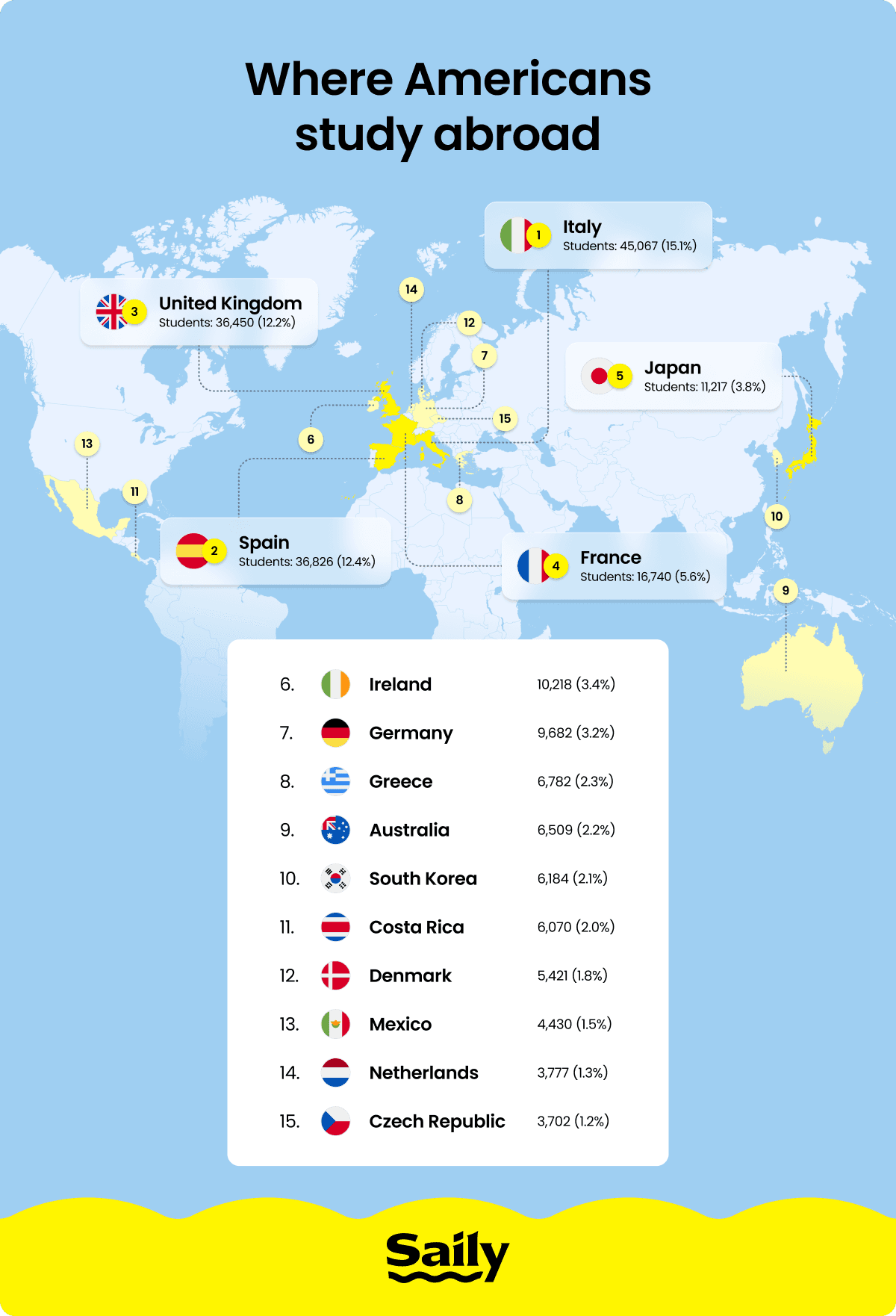
*According to a 2023/2024 report by Open Doors Data.
Stay online while you study abroad
While getting ready for your study abroad semester, you’ll be so busy figuring out what to pack and what paperwork needs to be filled out that one crucial need might slip under your radar — mobile data. Too many of us end up enabling our data roaming because we realize we’re offline once we leave the airport and end up incurring roaming fees. The easiest way to stay online throughout your study abroad program is with an eSIM (virtual SIM card) from an app like Saily.
Wondering how to get an eSIM? Follow these steps:
Search through Saily’s list of destinations.
Choose a data plan and go to checkout.
Once you’ve purchased your plan, you’ll immediately get instructions on how to install your eSIM.
And that’s it — you’ll have fast, affordable mobile data with no roaming charges in sight.

Discounted data plans for students
Enter the Saily coupon code at checkout and enjoy eSIM data for less!
FAQ


Related articles