




Does AT&T work in Canada? Coverage, data passes, and how to avoid roaming charges
Planning a trip to Canada and wondering if your AT&T phone will work? The short answer is that yes, AT&T works in Canada because the company has network partnerships with its neighbor up north. However, if your AT&T plan doesn’t offer coverage in Canada, you might need to buy a Roam North America data add-on or an International Day Pass to avoid AT&T’s steep pay-per-use roaming rates. This article will cover everything you need to know about AT&T’s coverage in Canada, what costs to expect, and why getting a Saily eSIM for Canada is a cost-effective alternative for staying online during your trip.

Table of Contents
- Yes, AT&T works in Canada (but here's what you should know)
- How does AT&T coverage work in Canada?
- Which AT&T plans include Canada coverage?
- AT&T plans that don't include Canada coverage
- AT&T Canada roaming options and costs
- Option 1: Included coverage with unlimited plans and the 4GB plan
- Option 2: Roam North America package
- Option 3: AT&T International Day Pass (US$12/day)
- Option 4: Pay-per-use rates (not recommended)
- Setting up your AT&T phone to use in Canada
- Before leaving for Canada
- When you arrive in Canada
- Common issues AT&T users face in Canada
- Better alternatives to AT&T roaming in Canada
- Get a prepaid eSIM for Canada (best alternative)
- Get a prepaid Canadian SIM card
- Renting a pocket Wi-Fi router
- Cost comparison: AT&T vs. a prepaid Saily eSIM plan
- Final verdict: Should you use AT&T roaming in Canada?
Yes, AT&T works in Canada (but here's what you should know)
If you’re an AT&T customer coming from the US, then your phone will absolutely work in Canada. However, costs for calling, texting, and using your international roaming will vary based on your specific mobile plan. If you've got one of AT&T's unlimited plans, you're in luck — Canada and Mexico coverage comes included. You won’t get daily flat fees for using your roaming, and you can use your plan in the same way as you would back home in the US. That said, you might face slower network speeds than you would expect back home, especially during peak hours — AT&T states on its website that roaming may be at 2G speeds in Canada. If you plan on making calls from Canada to other countries with your AT&T plan, international long-distance rates may apply.
If you don’t have an unlimited data plan, you might be able to add AT&T’s Roam North America feature at an additional cost to get unlimited talk, text, and data in Canada and Mexico. If, however, you aren’t able to add the Roam North America feature to your specific plan, you can purchase an International Day Pass for US$12 per day to use your mobile data.
The most unsavory scenario is paying AT&T’s pay-per-use roaming rates at US$2.05 per megabyte (MB). You can end up with these rates if your AT&T plan doesn’t cover Canada and you haven’t purchased a data package beforehand. With prices like this, it’s not unheard of to rack up a triple-digit bill over a short trip.
How does AT&T coverage work in Canada?
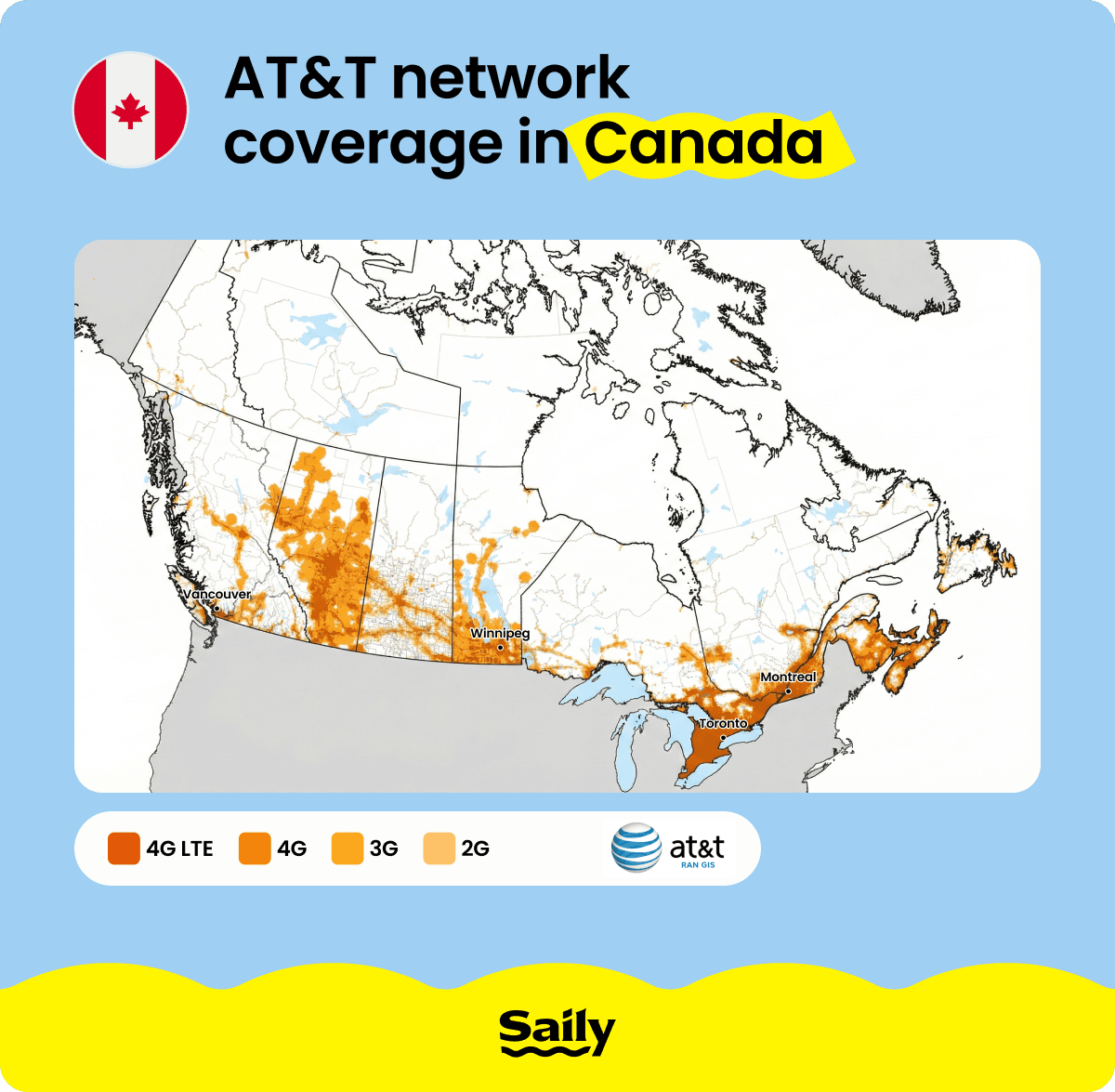
AT&T doesn't actually have its own cellular towers in Canada. Instead, it partners with Canadian wireless carriers like Rogers, Bell, and Telus to provide network coverage when you cross the border.
This partnership arrangement means your phone connects to available Canadian networks — you should see “ROGERS,” “BELL,” or “TELUS” at the top-right corner of your phone screen. When AT&T says Canada is "included" in your plan coverage, it means you won't pay extra roaming fees to have internet access, which is often the case if you use your roaming internationally. The coverage is generally solid in major cities and along highways, but rural areas can be hit or miss (just like in the US), and you might experience slower network speeds than when you’re using your data in the US.
If your data roaming is enabled, your phone will automatically connect to available Canadian networks. If you’re having trouble connecting to a Canadian carrier, you might need to manually select a network in your phone’s settings.
More generally, if you’re wondering whether your phone will work in Canada, the answer is yes as long as it’s unlocked and compatible with Canadian band frequencies (2G, 3G, and 4G/LTE). Notably, AT&T does not support 5G network speeds in Canada.
Which AT&T plans include Canada coverage?
Many AT&T unlimited plans include unlimited talk, text, and data in the US, Canada, and Mexico without roaming fees. AT&T also offers a 4GB plan, which includes 4 GB of data per line across the three countries. If you don’t have an unlimited data plan with AT&T, you still might be able to add its Roam North America package to get unlimited talk, text, and data in Canada.
Here are a few AT&T data plans that include coverage in Canada:
AT&T plan | Price per month | Data | Calls | Texts |
|---|---|---|---|---|
Unlimited Premium PL | US$50.99 | Unlimited, high-speed | Unlimited | Unlimited |
Unlimited Extra EL | US$40.99 | 75 GB high-speed, unlimited at slower speeds | Unlimited | Unlimited |
Unlimited Starter SL | US$35.99 | Unlimited at slower speeds | Unlimited | Unlimited |
Value Plus VL | US$50.99 | Unlimited | Unlimited | Unlimited |
4GB | Up to US$50 + deposit | 4 GB per line | Unlimited | Unlimited |
AT&T plans that don't include Canada coverage
If you're on one of AT&T's prepaid plans (US$40/month or less) or older limited data plans, talk, text, and data aren’t automatically covered in Canada. Unless you have an unlimited AT&T plan like the Unlimited Premium PL, Unlimited Extra EL, Unlimited Starter SL, Value Plus VL, or 4GB plan, you’ll either need to add a Roam North America data package to your mobile plan or buy an International Day Pass for US$12/day to stay online in Canada. Otherwise, you’ll be subject to abysmal pay-per-use rates at US$2.05/MB.
Some business plans also exclude international coverage, so check with AT&T before you travel if you're not sure what your plan covers.
AT&T Canada roaming options and costs
If data coverage isn’t included in your AT&T plan, you’ll either pay US$12/day for an International Day Pass that gives you unlimited talk, text, and data in Canada, or its much steeper pay-per-use rates of US$2.05/MB. You’ll only get charged for roaming in Canada if you haven’t planned ahead and purchased an International Day Pass.
Let’s break down all your options for roaming in Canada with AT&T and what costs to expect.
Option 1: Included coverage with unlimited plans and the 4GB plan
If you have AT&T’s Unlimited Premium PL, Unlimited Extra EL, Unlimited Starter SL, or Value Plus VL, you’ll get unlimited talk, text, and data in Canada with no extra roaming charges. With AT&T’s 4GB plan, you’ll get 4 GB of data per line in Canada.
However, AT&T states on its website that internet speeds might slow down to 2G during peak usage hours in Canada, and as a result, you might experience a more laggy browsing experience than you’re used to in the US. For more information, read Saily’s article on what a fair usage policy is.
Pros of using your AT&T unlimited or 4GB plan in Canada:

No international roaming fees.
Convenient — you’ll just need to make sure your data roaming is enabled.
You’ll get unlimited talk, text, and data with the unlimited plans. With the 4GB plan, you’ll get unlimited talk and text and 4 GB of data in Canada.
Cons of using your AT&T unlimited or 4GB plan in Canada:

You might get slower network speeds during peak usage hours.
Slowdowns are not ideal for data-heavy activities like FaceTiming or streaming videos.
If you only have the 4GB plan, you might need more than 4 GB of data in Canada.
Overall, this option is best for short trips where you’ll mainly want to send messages, browse social media, and use navigation apps without incurring roaming fees.
Option 2: Roam North America package
If Canada isn’t covered in your AT&T data plan, you might be eligible to purchase a Roam North America package — you’ll get unlimited talk, text, and data across the US, Canada, and Mexico. However, like with its unlimited plans, AT&T states on its website that internet speeds might slow down to 2G during peak usage hours in Canada.
Pros of getting a Roam North America package:
No international roaming fees.
You’ll get unlimited talk, text, and data in Canada.
Cons of getting a Roam North America package:
You can’t purchase this package with all AT&T plans — only select ones.
Slowdowns are not ideal for data-heavy activities like FaceTiming or streaming videos.
Overall, this is a great option if you don’t have an unlimited AT&T data plan but still want unlimited talk, text, and data in Canada without incurring roaming charges. However, you’ll need to check if you’re eligible for this package.
💡 Pro tip: Are you an American living abroad coming back for a visit? You can stay online with an eSIM for the United States or an eSIM for North America if you’re visiting Canada, too!
Option 3: AT&T International Day Pass (US$12/day)
If you don’t have an unlimited AT&T mobile plan and if you’re not eligible for a Roam North America data add-on, you can also purchase an International Day Pass for US$12/day to get unlimited talk, text, and data in Canada. If you want a day pass on a second line, it’ll be US$6/day. AT&T caps each billing period at 10 days, so your maximum charge for this pass is US$120 per month. For more information, check out Saily’s article on what “Current period roaming” means.
The International Day Pass will activate when you send your first text or make your first call in Canada, or when you arrive in the country, as long as your data roaming is enabled. You will only trigger another US$12 charge if you call, text, or use your data after 24 hours.
Pros of getting an AT&T International Day Pass:
No additional roaming fees.
You’ll get unlimited talk, text, and data in Canada.
You’ll only pay for the days you use.
If you’re heading to another international destination after Canada, your day pass will likely cover it (since it covers 210 destinations).
Cons of getting an AT&T International Day Pass:
It’s much more expensive than getting a prepaid eSIM for Canada.
You’ll get charged US$12/day whether you stream a video for hours or send a single text message.
Overall, getting an AT&T International Day Pass is a great option if Canada isn’t covered in your regular mobile plan and you’re ineligible for the Roam North America package. However, it’s not the most cost-effective way to get internet access in Canada because you’re paying a relatively steep daily flat fee no matter how much data you actually use within a 24-hour period.
Option 4: Pay-per-use rates (not recommended)
If Canada isn’t covered in your AT&T mobile plan and you haven’t purchased a Roam North America package or International Day Pass, you’ll be subject to AT&T’s extraordinarily expensive pay-per-use rates of US$2.05/MB. To put this in perspective, scrolling social media for one hour uses approximately 150 MB of data — that’s US$307.50. If you think that these rates are simply impossible, do yourself a favor and browse through r/ATT and take a look at what kinds of roaming bills travelers have been left with. Outgoing and incoming calls cost US$1 per minute in Canada, outgoing SMS texts cost US$0.50 per message, and outgoing SMS texts with pictures or videos cost US$1.30 per message.
The main takeaway here is to avoid AT&T’s pay-per-use rates at all costs. If adding one of AT&T’s data packages for Canada isn’t an option for you, consider getting an eSIM or a local SIM card instead.

Want to avoid AT&T’s pay-per-use roaming rates in Canada?
Saily offers affordable, flexible prepaid mobile data plans for Canada starting at US$5.29.
Setting up your AT&T phone to use in Canada
Getting your AT&T phone ready for Canada isn't complicated, but going through this checklist will save you unexpected charges and headaches.
Before leaving for Canada
Before you cross the border up north, make sure you’ve gotten the following steps out of the way to use your AT&T phone in Canada:
Check your plan’s coverage. Log in to your AT&T account or call customer service to confirm that calling, texting, and data are covered in Canada. Don't assume — double-check for peace of mind.
Purchase a Roam North America package or an International Day Pass if needed. If coverage in Canada isn’t included in your AT&T plan, consider getting a data add-on that gives you unlimited talk, text, and data in Canada.
Download offline maps. Even if you have mobile data, downloading maps for offline usage can save you if you hit a dead zone or experience connection issues.
Install backup apps. Having messaging apps like WhatsApp or Messenger that work over Wi-Fi is a great backup if you’re unable to send texts or if you’re experiencing issues with your data.
Update your apps. Make sure your apps are updated before you leave to avoid large downloads over potentially slower connections.
If you’re getting an eSIM for Canada, install it before you leave. If you choose to opt for a prepaid eSIM plan for Canada, install the eSIM on your phone so you have internet access when you arrive in Canada. Otherwise, you’ll need to find public Wi-Fi for the installation process.
When you arrive in Canada
Make sure you follow these steps when you arrive in Canada for your AT&T phone to work:
Turn on data roaming via your phone’s settings. If you’re using your AT&T mobile plan, you’ll need to make sure your data roaming is on so your phone can connect to Canadian networks. On an iPhone, go to “Settings” > “Mobile service.” Then, select your AT&T plan under “SIMs” and toggle the switches beside “Turn on this line” and “Data roaming” to the on position. On an Android device, go to “Settings” > “Connections” > “Mobile network” and toggle the switch beside “Mobile data” to the on position.
Select a Canadian network manually if needed. If you’re having trouble connecting to a Canadian network, you might have to manually select it in your settings. On an iPhone, go to “Settings” > “Mobile service.” Select your AT&T plan under “SIMs” and then tap “Network selection.” Toggle the switch beside “Automatic” to the off position and select whichever network comes up. On an Android device, go to “Settings” > “Connections” > “Mobile network.” Then, toggle the switch beside “Automatically select network” to the off position and manually select a network.
Make a test call or send a test SMS text. Try making a call, sending a text, or using your internet connection right when you get to Canada so you can troubleshoot issues early on in your trip.
Still confused about whether data roaming should be on or off? If you’re an AT&T user with an unlimited plan, a Roam North America package, or an International Day Pass, your roaming should be on. If your plan does not cover Canada and you haven’t purchased a data add-on, keep it off to avoid roaming charges.
Common issues AT&T users face in Canada
Even if everything's set up correctly, AT&T users coming from the US often run into a few problems in Canada.
Internet speed and network performance issues. A poor or spotty network connection in Canada is one of the most common complaints from AT&T customers online. Even if an unlimited AT&T plan includes coverage in Canada, internet speeds can drop to 2G during peak hours due to the fair usage policy. That means streaming videos or attempting to make video calls can feel especially frustrating during peak usage hours.
Unexpected charges. If you falsely assume that your AT&T plan offers coverage in Canada, you can be subject to data roaming charges of US$2.05/MB. Check your data usage regularly in your AT&T account, and if you see charges you don’t think are correct, contact AT&T’s customer support as soon as you can to dispute the charges.
Trouble connecting to Canadian networks upon arrival. Sometimes your cell phone just won’t connect properly to Canadian networks, and you may need to select them manually in your settings. If that doesn’t work, try restarting your phone or turning airplane mode on for 30 seconds, then off. If you have a physical SIM card, you can try removing it and reinserting it to try to connect to a local network.
Struggling with your AT&T eSIM? Read our in-depth troubleshooting guide if your AT&T eSIM is not working.
Better alternatives to AT&T roaming in Canada
Unless your AT&T plan already includes coverage in Canada, relying on an International Day Pass or pay-per-use rates is far more expensive compared to alternative ways to get internet access in Canada. Before enabling your data roaming for Canada for your AT&T line, consider the following alternatives.
Get a prepaid eSIM for Canada (best alternative)
One of the cheapest and most convenient alternatives to data roaming in Canada is getting a prepaid eSIM plan. An eSIM is a digital version of a SIM card. Instead of buying a tiny plastic card that you need to insert into your phone, you just download an eSIM app, buy a prepaid data plan for Canada, and install an eSIM on your phone. Instead of dealing with AT&T’s roaming limitations in Canada, you can get fast, reliable internet access in Canada with an eSIM. If your mobile phone supports dual SIM capabilities, you can keep your AT&T line on to receive calls and texts.
The main benefits of an eSIM are that you don’t have to worry about unexpected roaming charges that may show up if your AT&T plan doesn’t actually offer coverage in Canada. You’ll pay for a set amount of data and have a speedy internet connection the moment you arrive in the country. Plus, you won’t have to pop into a store to get a physical SIM card and risk losing your home SIM by removing it.
The Saily eSIM app is a fantastic option if you want affordable, reliable data in Canada. With Saily, you’ll get:

Fast, reliable mobile data across Canada.
Flexible fixed data plan options — 1 GB, 3 GB, 5 GB, 10 GB, or 20 GB.
Prices starting at just US$5.29.
24/7 live customer support.
An option for automatic data top-ups.
Three built-in security features — an ad blocker, web protection against malicious sites and trackers, and a virtual location changer.
Data saving features — Saily’s ad blocker helps you use 28.6% less data when enabled.
TL;DR: You can get a 20 GB Saily plan valid over 30 days for less than the cost of just four days of AT&T’s International Day Pass.
Need data in Canada? Get an eSIM!

1 GB
7 days
US$5.29
3 GB
30 days
US$12.99
5 GB
30 days
US$17.99
Get a prepaid Canadian SIM card
Another way to get mobile data in Canada without incurring roaming charges from AT&T is by getting a prepaid SIM card for Canada. You can buy a Canadian SIM card at the airport, convenience stores, or carrier stores and kiosks from Fido, Chatr, Virgin Mobile, or Lucky Mobile (all of which are owned and operated by Rogers, Bell, or Telus). However, prepaid Canadian SIMs are not cheap compared to local SIM cards in other countries — in fact, you’re usually charged an extra fee for the physical SIM card in addition to the plan. The cost of a tourist SIM card for Canada depends on the provider and the plan size, but the typical price range is from US$11 to US$40 for anywhere between 500 MB and 10 GB of data. As such, we’d recommend opting for a prepaid eSIM for Canada instead of a local SIM card.
If you’re deciding between an eSIM vs. a physical SIM card for Canada, note that eSIM plans tend to be much cheaper than local SIM cards, but they almost never include a local Canadian number, whereas SIM cards do. However, you can always make calls or send messages through apps like WhatsApp, Messenger, iMessage, or FaceTime, all of which only require mobile data or Wi-Fi.
Renting a pocket Wi-Fi router
Another way to avoid AT&T’s roaming charges and get internet access is by renting pocket Wi-Fi for Canada. Pocket Wi-Fi routers provide an internet hotspot for multiple devices at once, making them a relatively popular option for tourists traveling in groups or business travelers who need to use multiple devices for work. You can rent a pocket Wi-Fi router from online rental sites and have it shipped to your hotel or a residential address in Canada — prices are around US$6.20 to US$11.40 per day.
But not so fast — renting pocket Wi-Fi comes with a slew of cons:
Pocket Wi-Fi is more expensive than a prepaid eSIM for Canada. You’ll be paying between US$6.20 and US$11.40/day with the most popular pocket Wi-Fi rental companies. With a Saily eSIM plan for Canada, you can get 20 GB of data over 30 days for US$1.47/day.
You’ll need to be within range of the router to stay connected. Most routers have a range of about 30-50 feet — walk any further, and you’ll lose internet.
You risk losing or damaging the router. An extra device to carry around means you’ll have an extra device to lose or damage. In this situation, you’ll also owe the rental company a fee.
You might need a power bank to keep the battery alive. Pocket Wi-Fi devices will typically last you 6-8 hours when fully charged. If you have a packed itinerary, you might need a power bank to keep it alive for the whole day. That’s two extra devices to carry!
You’ll need to return the router before leaving Canada. It’s not exactly ideal to have to drop a router off in a mailbox or at the post office if you’re rushing to get home.
Overall, we’d recommend opting for a Saily eSIM for Canada over renting a pocket Wi-Fi router.
Cost comparison: AT&T vs. a prepaid Saily eSIM plan
Is a Saily eSIM for Canada cheaper than relying on roaming with AT&T? If you’re using an International Day Pass or AT&T’s pay-per-use roaming rates, then yes, a Saily eSIM for Canada is much more cost-effective. However, you won’t need to pay any additional costs if your AT&T plan already includes coverage in Canada — you’ll get unlimited talk, text, and data as you would back in the US.
Here’s an overview of how AT&T’s prices compare to a Saily eSIM for Canada:
Mobile data option | Price | Data allowance | Talk | Text |
|---|---|---|---|---|
AT&T unlimited plans (includes coverage in Canada) | US$0 | Unlimited (at throttled speeds) | Unlimited | Unlimited |
AT&T International Day Pass | US$12/day | Unlimited (at throttled speeds) | Unlimited | Unlimited |
AT&T pay-per-use rates | US$2.05/MB (US$2,050/ GB) | Unlimited (at throttled speeds) | US$1/min | US$0.50/text |
Saily eSIM for Canada | US$5.29 | 1 GB (7 days) | N/A | N/A |
Not only is a Saily eSIM for Canada cheaper than AT&T’s International Day Pass and pay-per-use rates, but it also comes with three built-in security features that add a layer of privacy to your browsing. Lower prices and stronger cybersecurity are a win in our books.
Final verdict: Should you use AT&T roaming in Canada?
If your AT&T plan includes coverage in Canada and allows you to call, text, and access mobile data at no extra cost, then AT&T roaming makes sense for your trip. However, getting a Saily eSIM for Canada (starting at US$5.29) is more affordable than purchasing AT&T’s International Day Pass (US$12/day) or paying its exorbitant pay-per-use rates (US$2.05/MB).
Use AT&T’s roaming in Canada if:
You have an unlimited plan that includes coverage in Canada.
You don’t mind the risk of incurring roaming charges.
You don’t want to install an eSIM, buy a local SIM card, rent a pocket Wi-Fi router, or rely on public Wi-Fi.
You don’t mind potentially slower network speeds than you’re used to in the US (for example, you won't get 5G).
Choose an eSIM for Canada instead if:
You want fast, reliable mobile data.
You don’t have an unlimited AT&T plan that includes coverage in Canada.
You want a cheaper mobile data option than AT&T’s International Day Pass or pay-per-use rates.
You’re a tourist or traveling for business.
All in all, the Saily eSIM app offers affordable prepaid plans for Canada, better network performance compared to AT&T roaming, and extra security perks unlike any other eSIM app on the market. If you’re looking for fast, reliable mobile data in Canada with no roaming charges waiting for you at the end of your trip, make sure to download the Saily eSIM app!
Don’t want to pay roaming charges in Canada?
Get reliable, high-speed data in Canada with a Saily eSIM. No surprise roaming fees, no SIM cards.
FAQ


Related articles