


What makes Rio Carnival the world’s most spectacular show?
Rio de Janeiro is home to a permanent population of over six million people, yet even that number feels modest once the Carnival season begins and the streets swell with the addition of two million visitors. For the uninitiated, this guide serves as a stable map through the euphoria, helping you navigate tickets, survival logistics, and cultural nuance. Is it worth the heat, the crowds, and the sensory overload? The answer is a categorical yes — Rio offers a full-body encounter with culture and craft, so step into the current and let it carry you along.


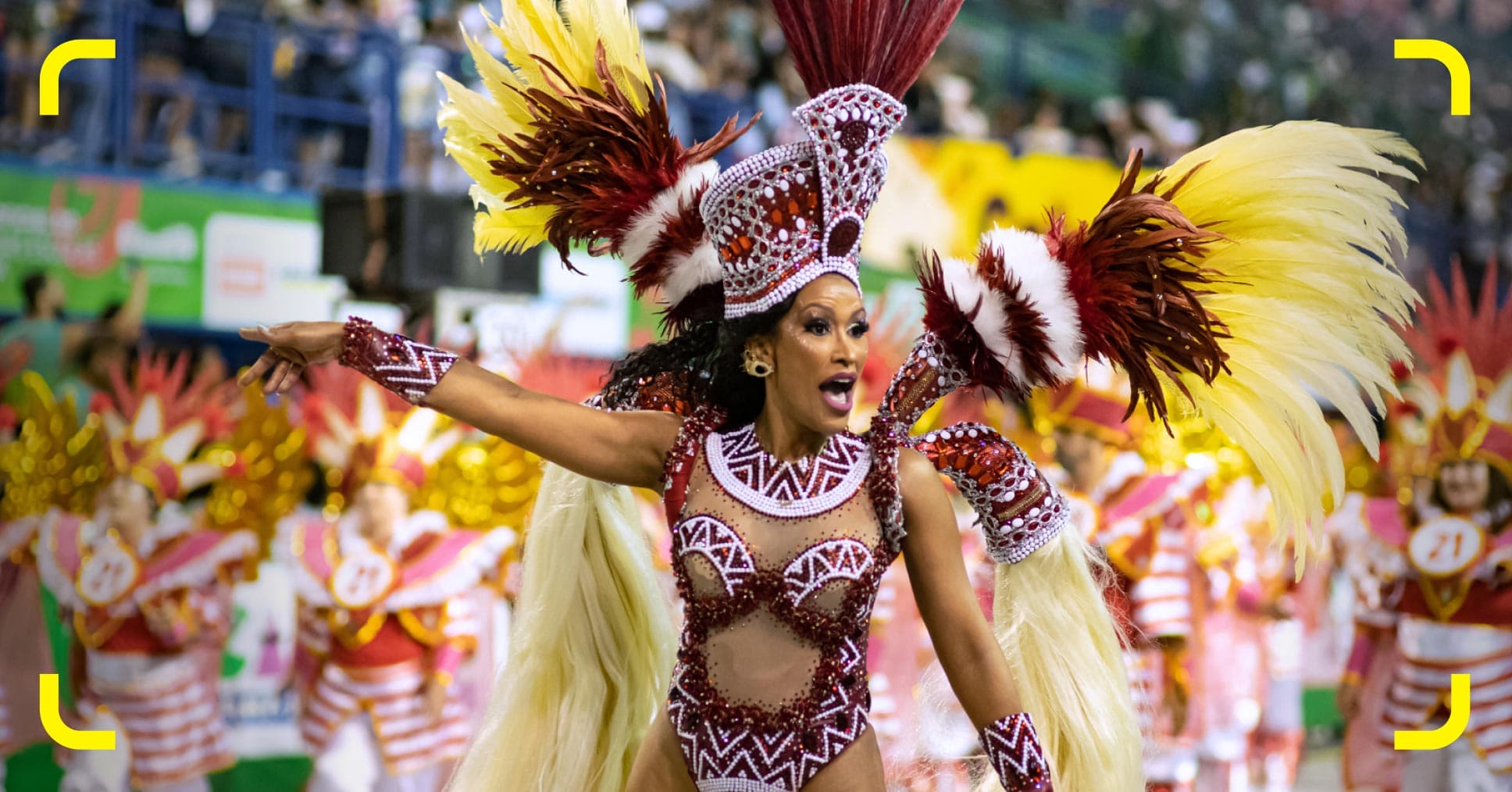
Table of Contents
- What is Rio Carnaval?
- When is Carnival in Rio de Janeiro 2026?
- How to book Rio Sambadrome tickets
- Rio Carnival experience
- A history built on sound
- What to wear — Rio Carnival outfits and costumes
- Brazilian food to try in Rio de Janeiro
- Staying connected and safe during Rio Carnival
- Best time to arrive in Rio de Janeiro
- Speak like a local: Portuguese phrases for Rio Carnaval
- Surrendering to the spectacle
What is Rio Carnaval?

The festival begins as an event on the Catholic calendar and then enters a separate cultural universe. Its origins lie in the pre-Lenten feasts of Europe where communities indulged before the austerity of fasting, but Brazil repurposed that impulse by merging Portuguese masquerade traditions with the percussive beats of West Africa and the mythology of Indigenous culture. The event calls itself Carnaval in Portuguese, a spelling you will see everywhere in Rio, though it refers to the same celebration English speakers call Carnival.
The beating heart of this spectacle is the Sambadrome Marquês de Sapucaí. This purpose-built concrete runway flanked by grandstands serves as the city’s competitive arena where 12 elite samba schools vie for the championship. But don’t think of these schools as casual social clubs. They represent entire neighborhoods and spend the year planning elaborate parades of floats with thousands of costumed performers, working together to tell one story.
When is Carnival in Rio de Janeiro 2026?
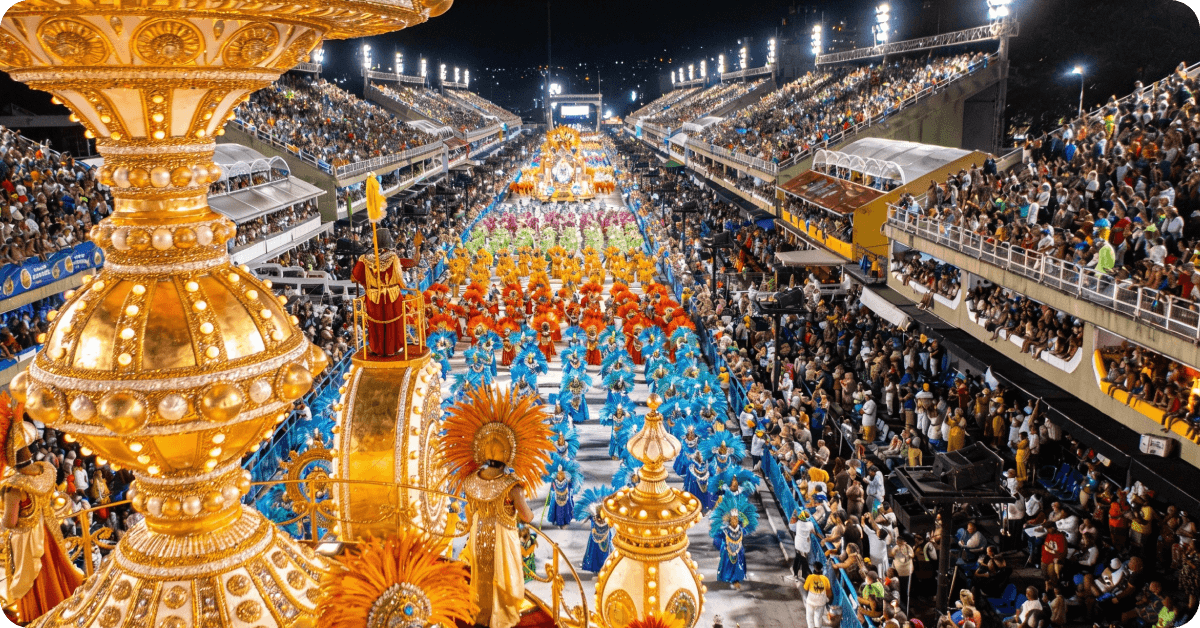
The 2026 edition of Rio Carnival will officially run from February 13-21. Because these dates remain tethered to the lunar calendar and Easter, the timing drifts each year between February and March. The official festival runs from Saturday to Ash Wednesday, while the main Sambadrome competitions unfold across five nights from Friday to Tuesday (February 13-17), when Rio's samba schools face off in their championship parades. Street parties begin weeks earlier and spread across the city, and after the winners are announced on Ash Wednesday (February 18), a final Champions' Parade on the following Saturday (February 21) gives the top schools one last turn under the lights. For real-time updates on schedules and official tickets, bookmark the official Rio Carnival website, follow LIESA updates and Riotur notices, then buy only through the listed official sellers.
How to book Rio Sambadrome tickets
Securing a spot in the Sambadrome requires foresight, as the most coveted tickets for the Special Group parades are scooped up months in advance. Sales occur through official channels like Ticketmaster Brazil or specialized travel agencies, where savvy visitors lock in their itineraries well before the new year to avoid the risks of buying on the secondary market. For those who miss the initial rush or wish to avoid peak pricing, the Access Group parades on Friday and Saturday offer the same spectacle at a lower cost, while the Champions’ Parade on the following Saturday allows for a more relaxed victory lap of the winning schools.
The venue itself segments the audience into distinct ecosystems of experience and cost. The Grandstands offer high concrete bleachers where the energy is a bit crude yet communal, placing you directly inside the roar of the crowd. Ground-level boxes known as frisas sit within shouting distance of the runway where the percussion vibrates through your chest, while the air-conditioned camarotes provide open bars and buffets for those seeking isolation from the heat. Consequently, the price of admission fluctuates wildly. A spot in the grandstands on a lower-stakes night starts around US$20, whereas prime placement on a main competition night can easily climb into four figures for a VIP suite.
Rio Carnival experience
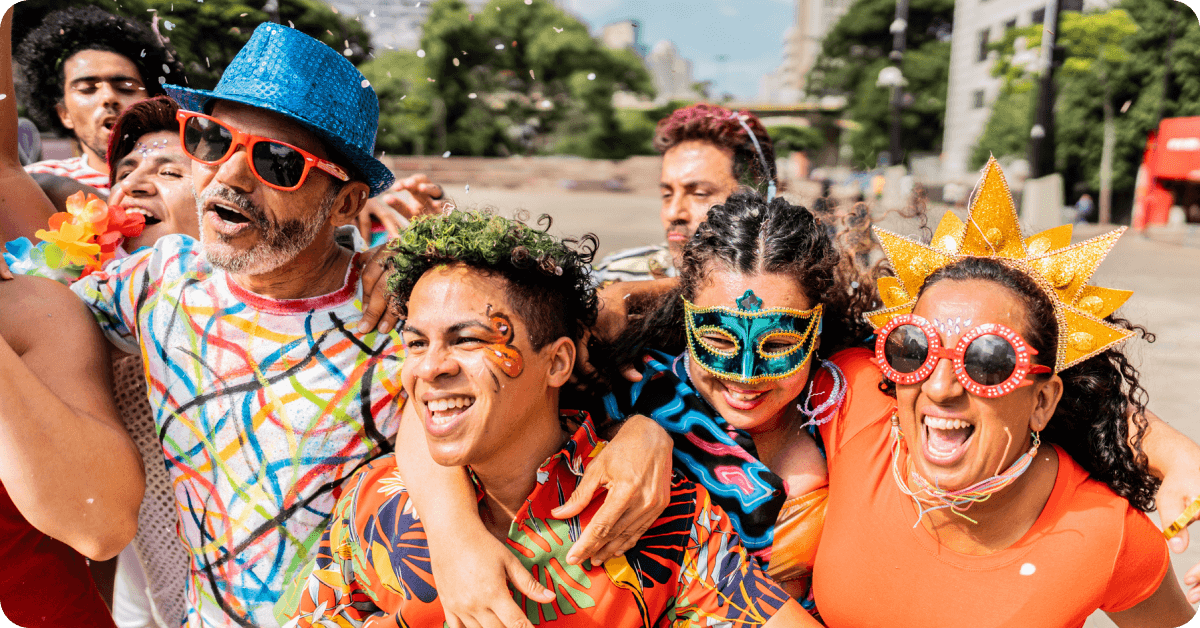
The festival can be described as a sensory invasion that dissolves the city’s normal boundaries. Before you even see the crowds, you’ll hear them in the form of brass bands warming up on side streets and the din of millions of feet on the pavement. The party fractures into hundreds of blocos, or street parties, where fifty thousand people might flow down a boulevard as a single, euphoric organism. Surviving this beautiful anarchy requires a solid strategy for hydration amidst the crushing humidity and a mindset of vigilance regarding safety, as the density of the crowds provides ample cover for pickpockets. Oh, and don’t forget that reliable mobile data becomes as essential as water, serving as your only tether to the outside world.
A history built on sound
Beyond the delightful chaos lies a deep history that elevates the Rio de Janeiro Carnival above a mere street party. The modern spectacle stands on the shoulders of Deixa Falar (“Let them speak”), the group founded in the Estácio neighborhood in the late 1920s that is widely credited as the first samba school in the world. It took the marginal energy of the streets and gave it shape, creating the template for the organized parades that define the city’s image today.
Every float and costume you see has a narrative purpose, driven by the samba enredo — an original anthem composed annually to narrate specific chapters of Brazilian history or folklore. Take the legendary 2019 parade by the Mangueira school, which challenged the country’s official textbooks by singing, “Brazil, the time has come to hear the Marias, Mahins, Marielles, and Malês.” With a single verse, the school honored assassinated councilwoman Marielle Franco alongside leaders of historic slave rebellions, forcing the crowd to remember the revolutionaries often erased from the official record. This defiance is only matched by the wardrobes in its ambition, so when a schoolteacher or a bus driver steps into elaborate gold-thread robes of a deity, they are manifesting dignity the music insists they possess in everyday life.
The sheer scale of the celebrations has earned Rio’s Carnival a reputation as one of the biggest popular festivals on the planet. While the massive sound trucks known as trios electricos dominate the celebrations in Brazil’s northeast, Rio offers a diversity of noise that ranges from acoustic percussion to bouncy bass. You can watch a video of the parades online, but the screen flattens the dimension of the event because it cannot capture the humidity or the physical vibration of the drums. It is a moment of raw, unfiltered fun, yet it carries a weight that feels significant by reminding everyone that fun is serious pursuit capable of suspending reality for five unforgettable days. Samba parades act as the mesmerizing center of this universe, but the true spirit lives in the collective agreement to set aside the ordinary for a while and embrace the revelry.
What to wear — Rio Carnival outfits and costumes
Inside the Sambadrome, the passistas (professional dancers) wear costumes that give them the appearance of moving sculptures inhabited by dancers. These elaborate constructions use wireframes, feathers, and heavy crystals designed to catch the floodlights while withstanding the violent torque of the samba.
On the street, the aesthetic shifts. You do not need to compete with the professionals to fit in. You simply need to outlast the heat. Breathable fabrics are non-negotiable in the Brazilian summer, so most revelers opt for shorts and tank tops elevated by a single transformative accessory like a neon wig, a cape, or the ubiquitous application of glitter. Footwear remains the most critical logistical choice of the trip. Since you will be standing on hot asphalt and navigating cobblestones for hours, sturdy sneakers are the only rational option.
Brazilian food to try in Rio de Janeiro
Carnival can be described as a caloric furnace, and Rio’s cuisine becomes its natural fuel. After hours on an outdoor dance floor, a salad will not suffice. Feijoada is the definitive answer to this hunger, a dense sediment of black beans and pork that makes for a satisfying and filling meal. It commands a slow afternoon, much like the churrascaria, where the salt-crusted beef arrives on skewers until you physically signal for it to stop. As the line often attributed to Tom Jobim goes, “Brazil is not for beginners,” a truth that applies as much to the country’s appetite as it does to its rhythm during the festivities.
Yet the festival also thrives on speed. The humble pão de queijo — a chewy, tapioca-flour cheese bread — functions as the ideal fuel for a crowd in motion, easily eaten between parades. When the palate finally tires of smoke and salt, moqueca offers a bright, fragrant pivot with local fish simmered in coconut milk and palm oil. To find the specific corners where these dishes are done best, be sure to read our full guide to Rio de Janeiro food.
Staying connected and safe during Rio Carnival
When the streets fill with millions of locals and tourists, a working phone is the difference between a stressful detour and a seamless night. Connectivity during Carnival is primarily a safety tool. It keeps you connected to Uber for late-night rides, lets you share live locations with friends in a crowd, and keeps essential apps working when it matters.
Need data in Brazil? Get an eSIM!

1 GB
7 days
US$3.99
3 GB
30 days
US$9.99
5 GB
30 days
US$13.99
Securing your connection should not require spending your morning in a cell phone shop. People visiting physical SIM kiosks at the airport often face long queues during peak season, and navigating SIM card registration in Portuguese can be frustrating. An eSIM bypasses this entirely, allowing you to install a data plan before you leave home so you can skip the counter and avoid unpredictable roaming fees. For those new to the concept, we explain the basics in our guide on how eSIM works, or you can go straight to securing an eSIM for Brazil to ensure you are online the moment you land!
Best time to arrive in Rio de Janeiro

Arriving on the first official day of Carnival is a tactical error. Your body needs time to calibrate to the humidity and the time zone before the marathon of parties begins. The ideal strategy is to land two or three days early, allowing you to stock your short-term stay with snacks and essentials, orient yourself in the neighborhood, and witness the city’s anticipation as it builds toward Carnival’s opening night. Expect the mid-summer weather to be atmospheric — heavy heat, long days, and violent afternoon rain showers that clear the air without stopping the music.
If you are crossing an ocean to get here, consider the logic of a wider itinerary. The flight to Rio is long, so a mere five-day trip is inefficient. A regional flight can easily connect you to Salvador, the urban majesty of São Paulo, or neighboring nations. Since Saily offers a regional eSIM for Latin America, border crossings no longer require swapping physical cards, which means one less thing to fumble with on your multi-country trips.
As for the logistics of booking, the window for spontaneity closes early. You should book flights and accommodation six to twelve months in advance. The best accommodations are secured by savvy travelers almost a year out, and as the dates for Carnival approach, you’ll have fewer options and have to pay more for them. Early commitment gives you control over your experience. When you are ready to prepare, download the Saily eSIM app to ensure your data is ready before you pack.
Speak like a local: Portuguese phrases for Rio Carnaval
Brazilians do not demand fluency, but they place a high value on the attempt. A simple "Bom dia" or a polite "Com licença" can change the temperature of an interaction, turning a transaction into a connection. While English works in major hotels, the streets run on Portuguese, and knowing the basics allows you to navigate the crowds with grace.
Portuguese | Phonetic | English |
|---|---|---|
Olá / Bom dia | oh-LAH / bohng JEE-ah | Hello / Good morning |
Por favor / Com licença | pohr fah-VOR / cohng lee-SEN-sah | Please / Excuse me |
Obrigado / Obrigada | oh-bree-GAH-doh / -dah | Thank you |
Onde fica...? | OHN-deh FEE-kah... | Where is...? |
Como chego em...? | KOH-moo SHEH-goo eeng... | How do I get to...? |
Onde fica o banheiro? | OHN-deh FEE-kah oo bahn-YEH-roh | Where is the bathroom? |
Socorro! / Ajuda! | soh-KOH-hoh / ah-ZHOO-dah | Help! |
Chame a polícia | SHAH-mee ah poh-LEE-see-ah | Call the police |
Estou perdido(a) | es-TOH pehr-JEE-doo (-dah) | I’m lost |
Feliz Carnaval! | feh-LEEZ car-nah-VAHL | Happy Carnival! |
Vamos sambar! | VAH-mooss sahm-BAR | Let’s samba! |
Que fantasia linda! | keh fahn-tah-ZEE-ah LEEN-dah | What a beautiful costume! |
Eu não falo português | eh-OH now FAH-loo por-too-GEHZ | I don’t speak Portuguese |
Saúde! | sah-OO-jee | Cheers! |
Mastering even three or four of these phrases shows respect for the person you’re talking to. When you raise a glass with new friends and say “Saúde,” or compliment a stranger’s elaborate outfit at the parade, you become a participant rather than just an observer. Even a tiny bit of linguistic effort unlocks the city, helping you navigate not just the madness of the Carnival but all the things you can do in Rio once the music fades. After all, this event runs on human connection, and a few words can be your key to inhabiting the spirit of Brazil’s Carnival
Surrendering to the spectacle
Rio de Janeiro in February operates on a frequency that defies standard travel logic. While other Brazilian cities host their own celebrations, the sheer scale of the street carnival in Rio consumes the landscape completely. The city’s streets surrender to a tide of live music, and the heavy summer air makes the whole experience feel visceral. To navigate this spectacle, tourists must balance the rigors of preparation with the willingness to let go. You organize and plan early to watch Rio’s samba schools execute their precise march through the stadium, but the massive street parties demand that you leave the itinerary behind and simply follow the noise.
Ultimately, the magic relies on the energy of the Brazilian people. They transform the summer heat into a shared euphoria that welcomes anyone willing to join in. If you arrive prepared — with your tickets booked and your connectivity sorted — you can stop worrying about the mechanics of the trip and can take time to learn Portuguese phrases, savor the chaos, and stand in the glitter and the heat, no longer just a visitor looking in, but a part of the world’s most vital human current.

Enjoy safer browsing with the Saily eSIM app
Saily is the only eSIM app with built-in online security features.