



Saily’s Internet Connectivity Index 2026
We looked at 97 countries to find where travelers can get safe, fast, and affordable internet on the road as well as where going online can turn into a headache.
Top 5 countries
| Rank | Country | Score |
|---|---|---|
| 1. |  | 65.98 |
| 2. |  | 65.55 |
| 3. |  | 64.78 |
| 4. |  | 63.50 |
| 5. |  | 63.11 |
The idea
What is the Internet Connectivity Index?
Going online is now a travel essential, but the ease of doing so changes the moment we cross borders. Some countries make it effortless, while others throw up walls like censorship, flaky networks, or eye-watering data prices. The Internet Connectivity Index scores these differences across four pillars.
Cyber safety
We scored each country’s network infrastructure, cybercrime response, and data-protection laws — high marks mean fewer risks with every tap.
Internet quality
What good is a destination if you can’t load a map? We rated countries on broadband and mobile performance, from video calls and streaming to uploading photos without delay.
Internet freedom
We scored how open each country’s internet really is, so you know if you’ll have access to your apps and news upon arrival in a destination.
Internet affordability
Affordable mobile data unlocks true digital freedom. We compared mobile plan prices to find out where going online is cheap and where doing so might sting.
Our findings
Which countries score the highest?
| Rank | Country | Score | |
|---|---|---|---|
| 1. | | 65.98 | |
| 2. | | 65.55 | |
| 3. | | 64.78 | |
| 4. | | 63.50 | |
| 5. | | 63.11 | |
| 6. |  | 61.82 | |
| 7. |  | 61.59 | |
| 8. |  | 60.98 | |
| 9. |  | 60.90 | |
| 10. |  | 60.74 | |
| 11. |  | 59.92 | |
| 12. |  | 59.86 | |
| 13. |  | 59.75 | |
| 14. |  | 59.53 | |
| 15. |  | 58.96 | |
| 16. |  | 58.93 | |
| 17. |  | 58.75 | |
| 18. |  | 58.71 | |
| 19. |  | 58.65 | |
| 20. |  | 58.62 | |
| 21. |  | 58.54 | |
| 22. |  | 58.47 | |
| 23. |  | 58.42 | |
| 24. |  | 57.79 | |
| 25. |  | 57.31 | |
| 26. |  | 57.13 | |
| 27. |  | 56.99 | |
| 28. |  | 56.89 | |
| 29. |  | 56.76 | |
| 30. |  | 55.66 | |
| 31. |  | 55.42 | |
| 32. |  | 55.12 | |
| 33. |  | 54.77 | |
| 34. |  | 54.15 | |
| 35. |  | 53.85 | |
| 36. |  | 53.81 | |
| 37. |  | 53.53 | |
| 38. |  | 53.44 | |
| 39. |  | 53.32 | |
| 40. |  | 52.81 | |
| 41. |  | 52.72 | |
| 42. |  | 52.46 | |
| 43. |  | 51.94 | |
| 44. |  | 51.27 | |
| 45. |  | 51.14 | |
| 46. |  | 51.08 | |
| 47. |  | 51.01 | |
| 48. |  | 50.74 | |
| 49. |  | 50.66 | |
| 50. |  | 50.54 | |
| 51. |  | 50.19 | |
| 52. |  | 50.19 | |
| 53. |  | 49.68 | |
| 54. |  | 49.59 | |
| 55. |  | 49.52 | |
| 56. |  | 49.37 | |
| 57. |  | 49.29 | |
| 58. |  | 49.13 | |
| 59. |  | 49.06 | |
| 60. |  | 49.04 | |
| 61. |  | 48.97 | |
| 62. |  | 48.51 | |
| 63. |  | 48.37 | |
| 64. |  | 48.29 | |
| 65. |  | 47.86 | |
| 66. |  | 47.64 | |
| 67. |  | 47.09 | |
| 68. |  | 46.55 | |
| 69. |  | 46.44 | |
| 70. |  | 46.26 | |
| 71. |  | 46.13 | |
| 72. |  | 45.99 | |
| 73. |  | 45.88 | |
| 74. |  | 45.76 | |
| 75. |  | 45.17 | |
| 76. |  | 45.13 | |
| 77. |  | 45.05 | |
| 78. |  | 44.80 | |
| 79. |  | 44.79 | |
| 80. |  | 44.13 | |
| 81. |  | 43.79 | |
| 82. |  | 43.42 | |
| 83. |  | 42.43 | |
| 84. |  | 41.99 | |
| 85. |  | 40.62 | |
| 86. |  | 39.75 | |
| 87. |  | 39.74 | |
| 88. |  | 39.62 | |
| 89. |  | 38.95 | |
| 90. |  | 36.31 | |
| 91. |  | 36.26 | |
| 92. |  | 36.24 | |
| 93. |  | 35.68 | |
| 94. |  | 35.48 | |
| 95. |  | 33.96 | |
| 96. |  | 33.44 | |
| 97. |  | 33.09 | |
Tracking the change
2025 to 2026: How the map moved
Rankings often change from year to year. We scored countries in four pillars in 2025 and 2026 to track which rose, which fell, and which held strong in the various categories.
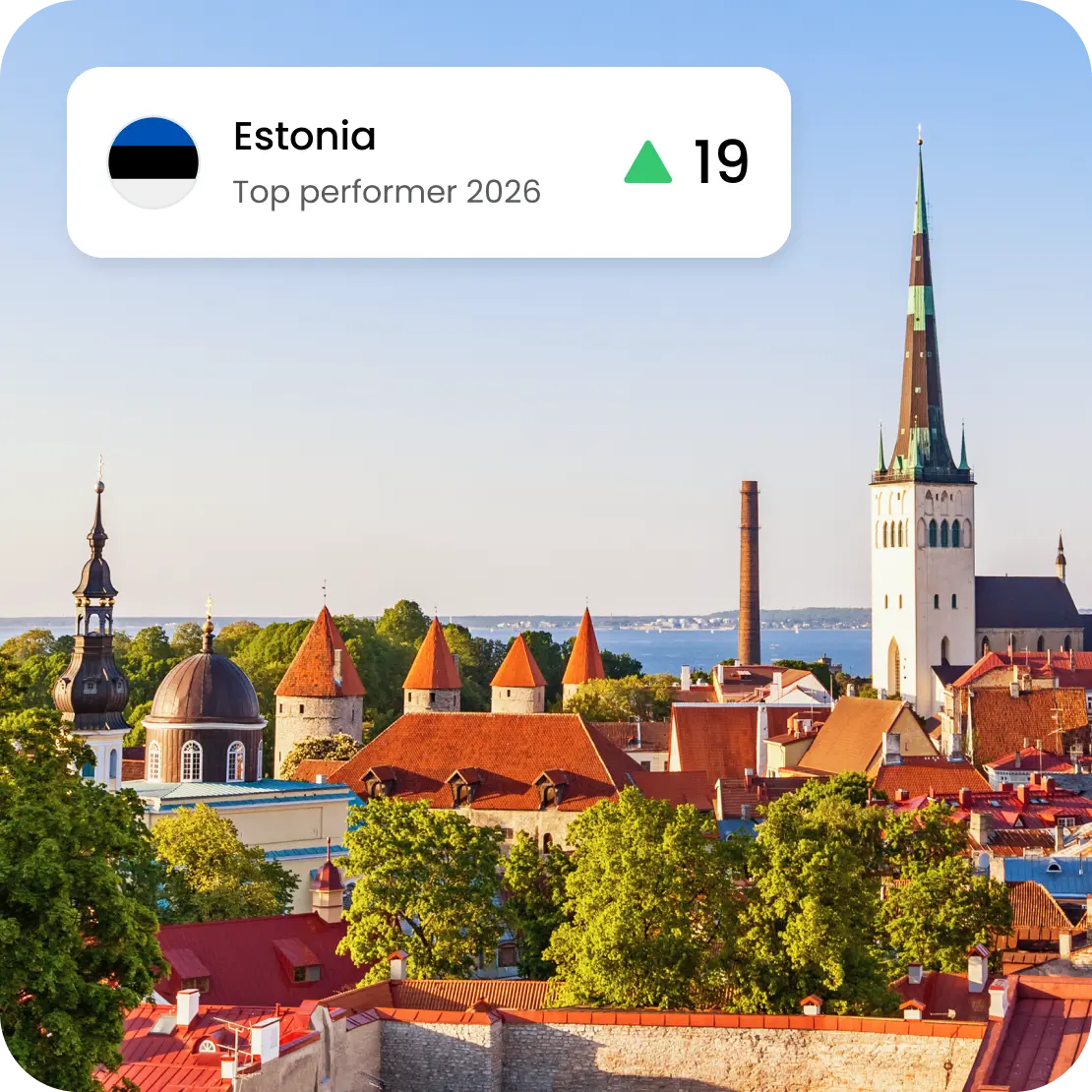
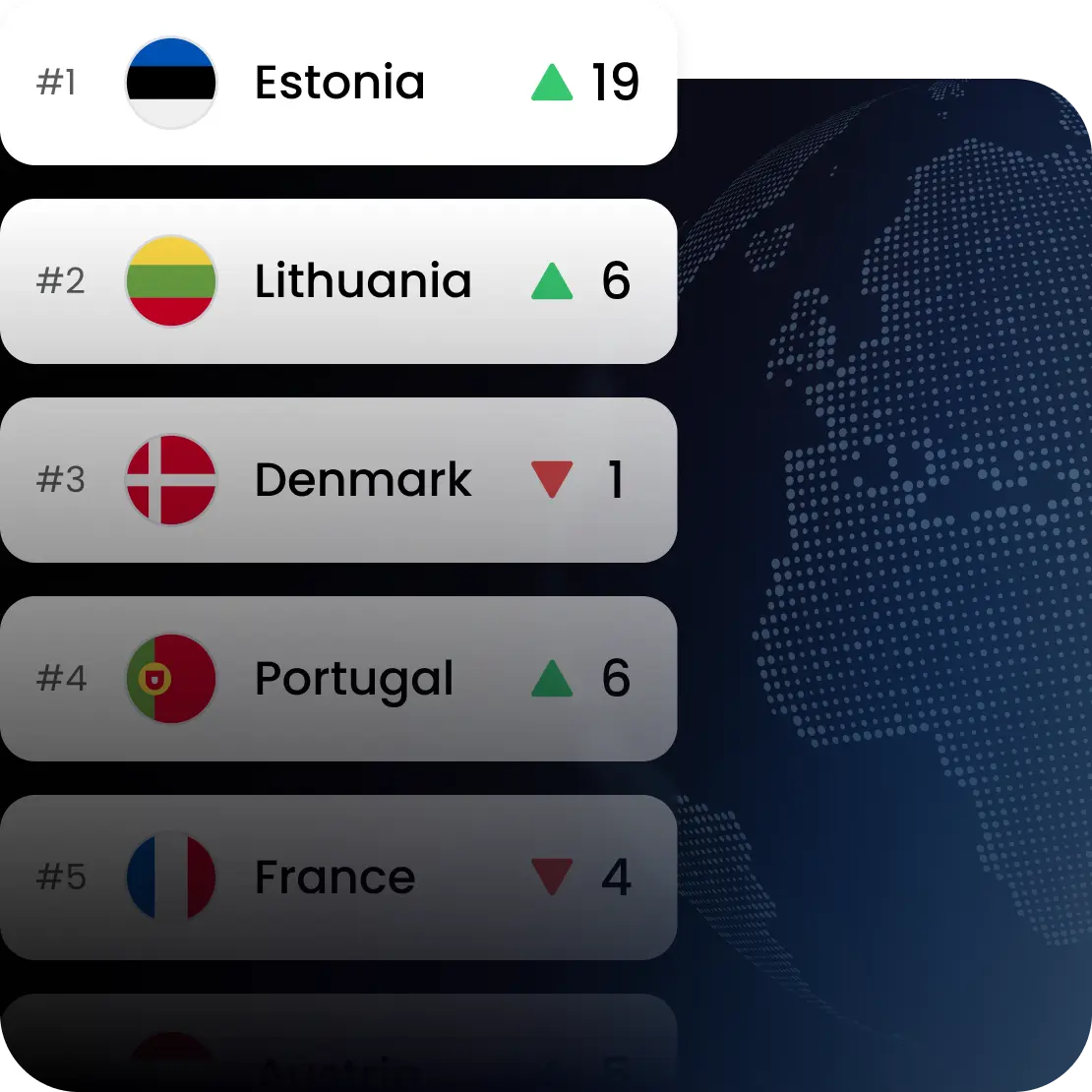
Estonia jumped from 20th to #1 with stronger quality and freedom scores, and Lithuania climbed from 8th to 2nd with gains in freedom and affordability.
Moldova rocketed from outside the top 60 into the global top 10, powered almost entirely by a surge in its freedom score.
South Asia was the world’s fastest-improving region, with Pakistan, Nepal, and Bangladesh posting the strongest gains in affordability and freedom.
Jamaica, Trinidad and Tobago, Panama, Bolivia, and Paraguay accounted for five of the 10 biggest declines globally, driven by worsening affordability and eroding freedom scores.
Ukraine, Kazakhstan, and Kyrgyzstan led Eastern Europe and Central Asia’s climb, fueled mainly by rising freedom and affordability scores.
Tanzania, Nigeria, and South Africa led Sub-Saharan Africa’s gains, driven by rising cyber safety and affordability.
Our insights
What does the data tell us?
Stay connected wherever you land
The local networks determine your speed, but Saily helps keep mobile data costs under control wherever you travel. Set your eSIM up before you fly, connect when you land, and save on Saily data plans this summer!
What do these numbers mean?
We combined travel needs with global data to rate how user friendly a country's internet is. Every country was scored across four equally weighted pillars: safety, quality, freedom, and affordability — each worth 25% of the final score.
Each score was standardized to a 0-100 scale:
Above 50: Above-average performance
50: Global average
Below 50: Below average
Our data came from trusted international reports and indices, including the ITU Global Cybersecurity Index, the GSMA Mobile Connectivity Index, and the Human Freedom Index. We prioritized the newest data — mostly from 2024, 2025, and 2026 — with a few older figures plugging the gaps.
