Best places to live in Portugal: Quick overview
Relocating to an ancient European city means inserting a new household into an established, delicate social fabric. The recent influx of foreign capital has strained local housing markets, pushing many native residents out of historic urban centers. Selecting a base requires balancing personal logistics with an understanding of where international infrastructure already exists and where local markets can organically absorb new arrivals without severe displacement.
Expat profile | Top locations | Suitability and community fit |
|---|
Expat families with kids | Cascais, Sintra, Braga | Cascais and Sintra hold the country’s highest concentration of international schools and pediatric clinics, confining higher-budget family footprint to areas already zoned for expatriates. Braga offers an alternative in the north, presenting a highly residential, family-oriented city layout where expats can expect a smoother integration alongside young Portuguese families instead of more gentrified areas of Lisbon. |
|---|
Expat retirees | Algarve (Tavira, Faro), Madeira | These regions established their foreign-friendly infrastructure decades ago. English-speaking medical facilities and well-organized social networks exist independently of the working-class urban centers, allowing retirees to settle comfortably without disrupting local professional housing markets. |
|---|
Expat students | Coimbra, Porto, Lisbon | Coimbra centers entirely around its historic university, providing a housing market already structurally designed for high turnover and academic life. Porto and Lisbon offer dense public transit and leading national universities, though students must navigate highly competitive rental markets in these commercial hubs. |
|---|
Before getting into the reasons Americans choose Portugal, it helps to sort out one practical detail early. An eSIM plan for Portugal from Saily can make the first days of a move easier, especially when you’re relying on maps, messages, and apartment viewings.
Why do Americans move to Portugal?
Portugal became one of the main European destinations for American expats through policy as much as appeal. Over the past decade, the country opened visa pathways for passive-income residents and remote workers, which made a move there easier to imagine and easier to organize. Few other European countries built that kind of access so clearly. Here are the main reasons Americans keep choosing Portugal:
Lower cost of living: Daily expenses, groceries, and healthcare often are half the cost of their American equivalents. Even in the capital city of Lisbon, a comfortable lifestyle requires significantly less capital than in comparable US tech hubs.
Favorable visa options: The D7 passive income visa targets retirees and those living on pensions or investments, while the D8 visa explicitly targets digital nomads earning remote salaries from foreign employers.
Accessible healthcare: Legal residents gain access to the public SNS health system. Parallel private insurance policies rarely exceed US$150 a month, providing fast access to English-speaking specialists.
Safety and political stability: Portugal consistently ranks in the top ten of the Global Peace Index. Strict gun control and remarkably low violent crime rates offer a level of daily security that registers immediately for arrivals from major American cities.
Higher quality of life: A slower cultural rhythm emphasizes community and outdoor living. Securing an apartment near a historic city center often places cafes, grocers, and public transit within easy walking distance.
Warm climate: The southern coastline guarantees over 300 days of sunshine annually, maintaining the country's status as one of Europe's most visited tourist destinations.
English-speaking environment: While genuine immersion in Portuguese culture requires learning the language, the high baseline of English fluency across the service sector reduces the immediate friction of arrival.
Proximity to the rest of Europe: A residency card unlocks visa-free travel across the Schengen Area, placing dozens of European countries within a short, inexpensive flight.
The advantages above depend almost entirely on maintaining a foreign income stream denominated in dollars. Earning locally, on a wage economy that averages below €1,500 a month, erases the cost-of-living differential almost immediately. But this structural reality — thousands of foreign residents spending US dollars in a euro economy — carries a visible social cost. Renting a one-bedroom apartment in central Lisbon now consumes roughly 63% of the average Portuguese worker’s monthly salary.
Portuguese officials have since rolled back several of the visa schemes that initially attracted the international remote workforce. The whole picture is more complicated than the expat blogs suggest: Foreigners accounted for just 5% of home purchases in 2025, yet they remain the most visible symbol of a housing market that has pushed native residents out of neighborhoods their families occupied for generations. Arriving as a thoughtful, long-term participant in Portuguese civic life, rather than as a temporary consumer of its affordability, is the distinction that separates integration from displacement.
TOP 10 best places to live in Portugal
The list below spans mainland Portugal from its rain-soaked northern highlands to the southernmost region of the Algarve, and stretches further still to an Atlantic archipelago that technically qualifies as a different continent. Each entry represents a distinct lifestyle contract — different budgets, different climates, different social fabric — because Portugal’s geography can’t be reduced to a single stereotype.
1. Lisbon
The main city and capital, Lisbon draws nearly three million residents into its greater metropolitan area. The city is simultaneously a historic port and one of Europe’s fastest-growing tech hubs. Rents in central neighborhoods like Chiado and Principe Real exceed US$1,620 a month — the most expensive landing pad in the country, yet still cheaper than comparable capitals across European countries. The public transportation network of metro lines, trams, and suburban rail handles most daily movement without requiring a car.
Best for: digital nomads, young professionals, and expats requiring daily US flight connections.
2. Porto
Rising above the Douro River, Porto carries a working-class authenticity that Lisbon increasingly struggles to preserve. At roughly one million residents in the greater area, Porto is known for urban density at a noticeably lower price point. One-bedroom apartments average US$1,160 to US$1,450 a month. The coastal areas of nearby Matosinhos add Atlantic beach access to an otherwise river-defined city.
Best for: culturally curious expats and remote workers seeking a lower cost base than Lisbon.
3. Cascais
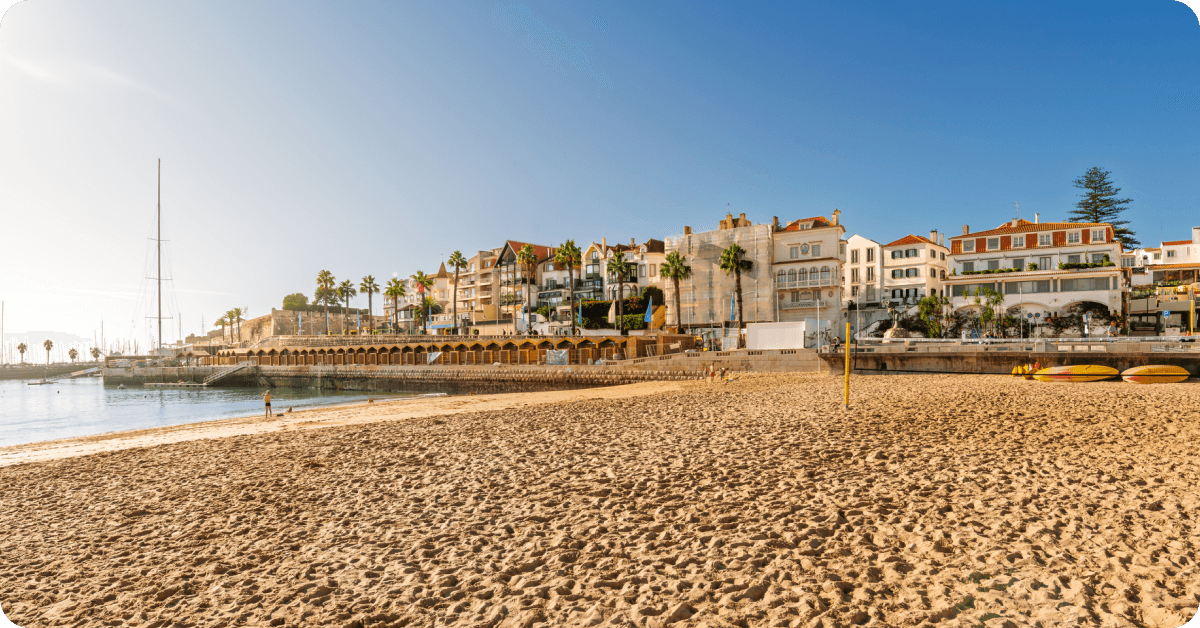
Cascais offers a picturesque coastline of sheltered Atlantic bays with sandy beaches within easy walking distance of the town center. One-bedroom rentals start at US$1,160 but scale sharply upward near the water, a premium justified by the concentration of international schools and English-language medical clinics. The expat community here skews permanent rather than transient, drawn by a slower pace and a strong civic identity independent of Lisbon.
Best for: expat families with children and retirees with higher budgets.
4. Algarve
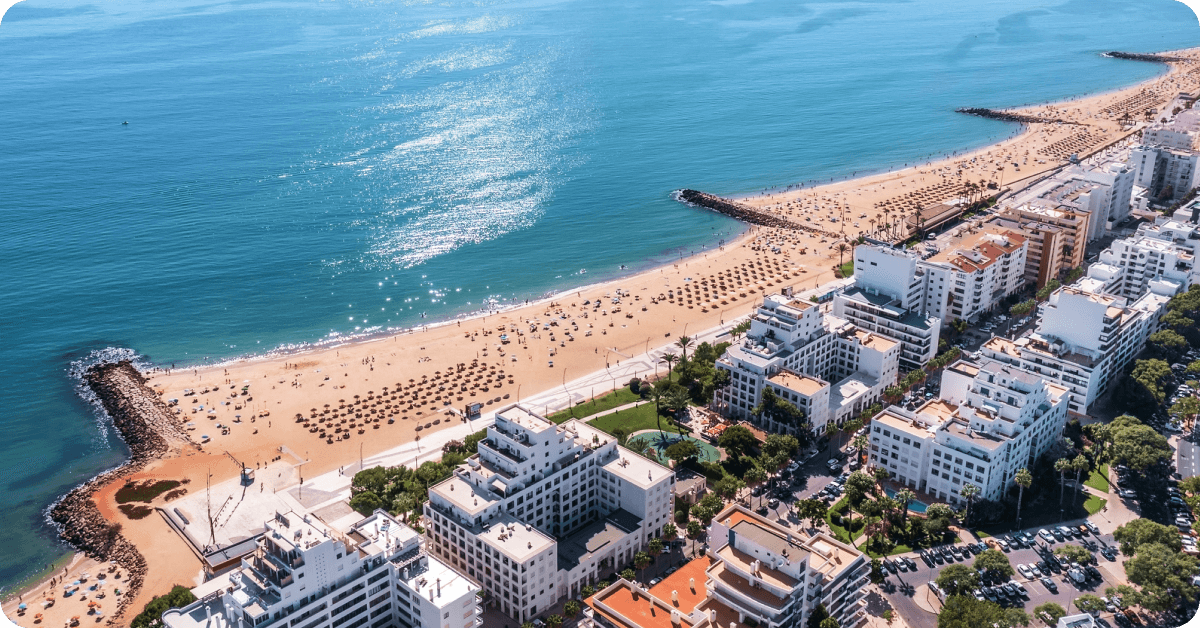
The southernmost region of Portugal, known as Algarve, is home to over 100,000 foreign residents. Here you can find more than 40 golf courses, dramatic sandstone cliffs, and sandy beaches that dominate global travel rankings. Rents range from US$930 a month near Faro to luxury villa rates in Quinta do Lago. The Spanish border sits a short drive east near Vila Real de Santo Antonio. The summer months bring intense crowding, but winters in Algarve are pleasantly quiet.
Best for: retirees, golf enthusiasts, and sun-seekers committing to a permanent base.
5. Braga
Consistently overlooked, Braga makes the strongest financial case for expat relocation in the north. One-bedroom apartments average US$700 a month, and three-bedroom units with garden space regularly appear in listings below US$1,160. The city of 121,000 is known for an expanding tech sector and is home to one of the oldest functioning cathedrals in Portugal. Heavy winter rain is the non-negotiable trade-off, though.
Best for: budget-conscious families and remote workers seeking an authentic Portuguese city rather than an expat enclave.
6. Faro (Algarve)
The administrative capital of the Algarve, Faro maintains year-round urban functionality that the purely seasonal resort towns further west cannot match. The region’s only international airport places dozens of European countries within a three-hour flight, and the University of the Algarve keeps a permanent student population, adding vibrancy to the city’s streets. One-bedroom apartments near the historic center average US$930 a month.
Best for: retirees and remote workers prioritizing urban practicality over resort prestige.
7. Aveiro
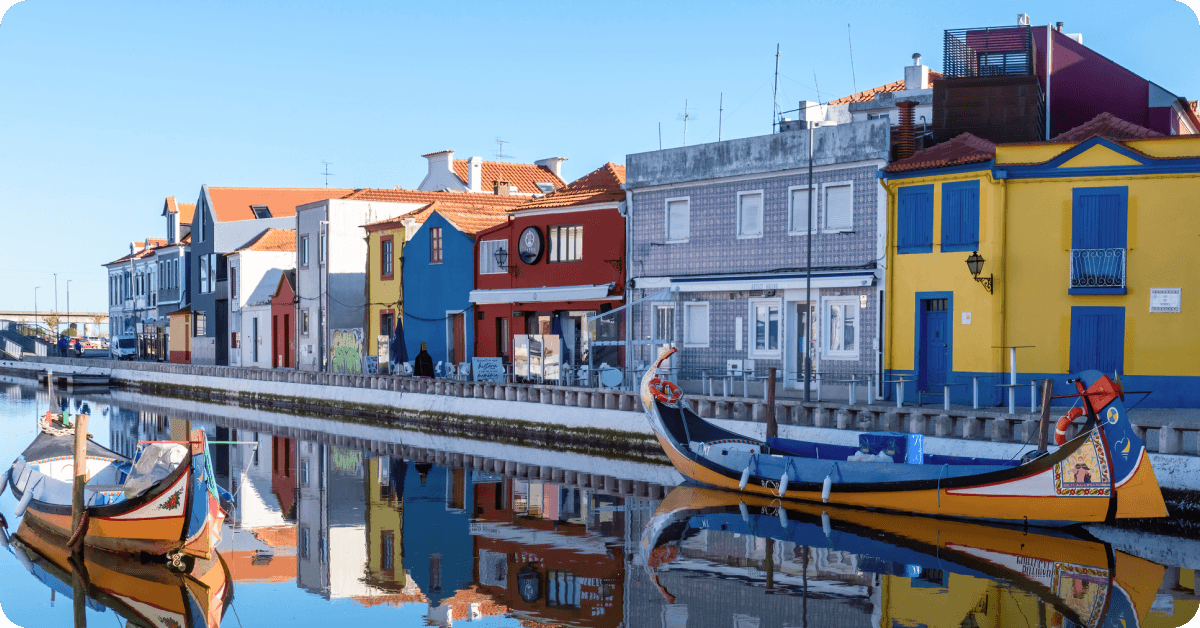
Known as the Portuguese Venice, Aveiro occupies the Silver Coast roughly halfway between Lisbon and Porto, offering one-bedroom apartments from US$580 to US$750 a month — among the lowest figures on this list. The surrounding coastal areas include the vast Ria de Aveiro lagoon and the Atlantic-facing beach of Costa Nova.
Best for: budget-conscious expats seeking an immersive Portuguese experience.
8. Madeira (e.g., Ponta do Sol, Santa Cruz)
Rising from the Atlantic roughly 600 miles southwest of mainland Portugal, Madeira has a subtropical climate year-round and launched the world’s first official digital nomad village in Ponta do Sol in 2021. One-bedroom rentals in Funchal average US$930 a month, and the volcanic landscape — levada hiking trails, black sand beaches, cloud forest — offers an environment no coastal area on the mainland replicates. But keep in mind that it takes a two-hour flight from Lisbon to reach Madeira.
Best for: digital nomads and nature-oriented retirees seeking mild weather without mainland overcrowding.
9. Sintra / Linho
Mist frequently blankets the UNESCO-protected forests surrounding this royal retreat fifteen kilometers northwest of the capital, producing a microclimate far cooler than the neighboring coast. The presence of the Carlucci American International School in nearby Linho turns the municipality into a high-demand corridor for American families requiring a US-curriculum education. Because the property market caters to diplomats and high-earning expats, you can anticipate monthly rents well over US$1,740 for a standard home.
Best for: American families with school-age children and high-budget expats prioritizing natural beauty.
10. Coimbra
Positioned in Central Portugal, Coimbra draws its civic and economic identity from a university founded in 1290. The constant rotation of students stabilizes the local housing market, holding the rent for a central one-bedroom apartment between US$580 and US$700 a month. Retirees managing strict visa income requirements will find the math highly favorable, trading the gentrified coast for this affordable academic base.
Best for: expat students, academics, and retirees on strict D7 visa income thresholds.
City / Region | Pros | Cons |
|---|
Lisbon | Features the best transit network, daily US flights, and a thriving tech scene. | Suffers from the highest rents in Portugal, heavy gentrification, and high tourist footfall. |
|---|
Porto | Maintains a rich cultural identity, lower living costs than Lisbon, and a walkable river core. | Endures cold and wet winters, steep terrain, and a highly competitive rental market. |
|---|
Cascais | Offers high safety ratings, international schools, and Atlantic beaches near the town center. | Carries premium rents, a saturated expat market, and limited affordable housing. |
|---|
Algarve | Guarantees over 300 days of sunshine, dozens of golf courses, and established expat networks. | Experiences seasonal economic swings, high car dependency, and severe summer overcrowding. |
|---|
Braga | Stands as the most affordable major city, holding a growing tech sector and spacious apartments. | Features heavy winter rainfall, a long distance from the coast, and fewer English speakers. |
|---|
Faro | Sustains a year-round urban pulse, an international airport, and affordable rents. | Faces a lagoon separating the city from the ocean, and offers lower resort prestige. |
|---|
Aveiro | Remains highly affordable, architecturally unique, and connected to Porto by a direct rail line. | Contains fewer English speakers, a smaller expat community, and limited nightlife. |
|---|
Madeira | Enjoys a year-round subtropical climate and pioneering digital nomad infrastructure. | Demands absolute island isolation, difficult driving terrain, and a two-hour flight to the mainland. |
|---|
Sintra / Linho | Provides a US-curriculum international school, a UNESCO-protected landscape, and proximity to Lisbon. | Suffers from constant winter dampness, heavy tourist traffic, and premium property prices. |
|---|
Coimbra | Offers the lowest rents on the list, a historic university environment, and central rail connections. | Occupies an inland location, steep geography, and limited expat amenities. |
|---|
Things to know before moving to Portugal
Portugal can be an excellent place to live, but the romance usually fades the moment the paperwork starts. Long before you settle into a café routine or learn your neighborhood bakery hours, you will be dealing with visas, rent, tax numbers, and the ordinary mechanics of daily life. That part is less glamorous, but it matters more than the view from the apartment window. The sections below cover the points that tend to shape the move most: legal entry, monthly costs, housing pressure, schools, work, weather, and healthcare.
Requirements for moving to Portugal
National rules distinguish between temporary stay visas for periods under a year and residency visas for people planning a longer move. A residency visa is valid for four months and two entries, and during that window the holder must apply for a residence permit with AIMA. For most Americans, the practical routes are a passive-income residence visa, a remote-work or the Portuguese “digital nomad” visa, or a work visa tied to a Portuguese employer. Portugal’s current means-of-subsistence rule uses €920 a month for the first adult, which comes to about US$1,081, with additional requirements for other adults and dependent children.
Costs of living in Portugal
The broad answer is still yes, Portugal is cheaper than the United States, but that answer becomes more nuanced once you start comparing neighborhoods. Latest country-level estimates put monthly costs for one person at about US$790 before rent, while a family of four lands around US$2,855 before rent. A typical one-bedroom apartment averages about US$1,060 in a city center and US$848 outside it. Add roughly US$137 for basic utilities, US$42 for internet, and about US$47 for a regular monthly public transport pass, and the shape of an ordinary budget starts to come into focus. Lisbon sits at the top of the scale, with a one-bedroom averaging about US$1,600 in the center, while Porto comes in closer to US$1,292, Braga about US$952, and Coimbra about US$911. Groceries, cafes, and transit can still feel reasonable by American standards.
Accommodation in Portugal
Rent has climbed sharply in high-demand areas, especially in Lisbon, Porto, Cascais, and parts of the Algarve, and availability can be tight even for well-prepared renters. A one-bedroom outside the center averages about US$1,234 in Lisbon, US$952 in Porto, US$769 in Braga, and US$668 in Coimbra. The visa process adds pressure because many applicants need proof of accommodation before arrival. It also pays to inspect older homes in person, because a charming apartment can still be cold, damp, or poorly insulated in winter.
Education in Portugal
Public education is free, and compulsory schooling runs from ages 6 to 18, while preschool is now widely available from age three. Foreign students make up 16.4% of pupils in public education, and schools provide structured support for children who do not yet speak Portuguese fluently. That makes the public system an option for families open to language immersion.
Finding a job in Portugal
Portugal’s unemployment rate stood at 5.6% in January 2026, and average gross monthly earnings reached US$1,990 in 2025, with regular monthly earnings at about US$1,604. Those figures help explain why many expats prefer to keep foreign income if they can. Finding work without Portuguese can be difficult, although customer service, IT, agriculture, and parts of hospitality tend to offer more openings than other sectors.
Climate in Portugal
Portugal does not have one single climate. The north is cooler and wetter, the interior experiences greater swings between summer and winter, and the south is warmer and drier. Madeira stays mild through the year, while the Azores are greener and wetter. Many Americans arrive expecting endless sun, then discover that winter indoors can feel colder than expected.
Health care in Portugal
Portugal’s public healthcare system, the SNS, is open to foreigners who are legally resident in the country. A valid SNS user number gives access to public healthcare, but full registration depends on having your ID, Portuguese tax number, local address, and residence permit in order. Many expats still choose private insurance because it offers shorter wait times and more provider choice. In practice, many residents use both systems rather than relying on only one. That approach usually gives the best mix of affordability and flexibility.
Mobile service providers
Getting internet in Portugal is straightforward — the main mobile carriers are MEO, Vodafone, and NOS, and coverage is generally strong in cities and along the country’s main travel routes. For short stays, Saily is often the simpler place to start, especially if you want mobile data ready before arrival instead of setting up a local contract right away. Longer contracts make more sense once you have a Portuguese tax number, a local address, and the rest of your paperwork in place. If you want to compare both setups first, our guide to SIM cards in Portugal explains the traditional route, and our explainer on what an eSIM is breaks down how eSIM technology works.
Saily’s eSIM for Portugal can be installed before the trip on a compatible phone, so you can land with mobile data already working. That means no store visit, no waiting for a SIM card, and no need to swap out your home line just to get connected. If your device supports eSIM technology, you can download the eSIM app before departure and choose a plan that fits the length of your stay.
So, what is the best place to live in Portugal?
The best place to live in Portugal depends on the kind of life you want to build. Lisbon suits people who want the most international city, strong public transportation, and easy flight connections. Porto offers more character and a lower cost base, while Cascais and the Algarve appeal to families and retirees who want more sun and a slower daily pace. Braga, Coimbra, Aveiro, and Madeira can make more sense for people who care most about budget, calm, or a stronger connection to local life.
If you’re looking for the safest choice, Lisbon usually comes first for convenience, services, and access. For many Americans, though, the better answer sits somewhere beyond the obvious. Portugal is small, but daily life changes quickly from one place to the next. The right move depends on how much city you want, how much rent you can carry, and how seriously you plan to build a life there instead of simply starting over somewhere sunnier.