






Désolés, mais cet article n’est pas encore disponible dans la langue de votre choix.
Saily’s Internet Connectivity Index maps the best countries to get online in 2025
In the last decade, the hierarchy of travel needs has shifted. Food and accommodation still matter, but for a traveler abroad, a dead signal is the ultimate vulnerability. Whether it’s accessing a digital boarding pass, translating a pharmacy label, or navigating a sprawling metropolis, connectivity is now a prerequisite for safe mobility. But as Saily’s new Internet Connectivity Index reveals, the digital map is as fragmented as the political one, with deep disparities in internet access across every border.
Sommaire
- Decoding the digital divide
- Cyber safety in practice
- Internet quality during a trip
- Internet freedom while abroad
- Affordability and its real impact
- The global winners: Europe’s digital seamlessness
- The high cost of quality: The North American paradox
- The invisible wall: Where speed meets censorship
- The volatility of emerging markets
- How Saily built the Internet Connectivity Index
- The new border crossing
Decoding the digital divide
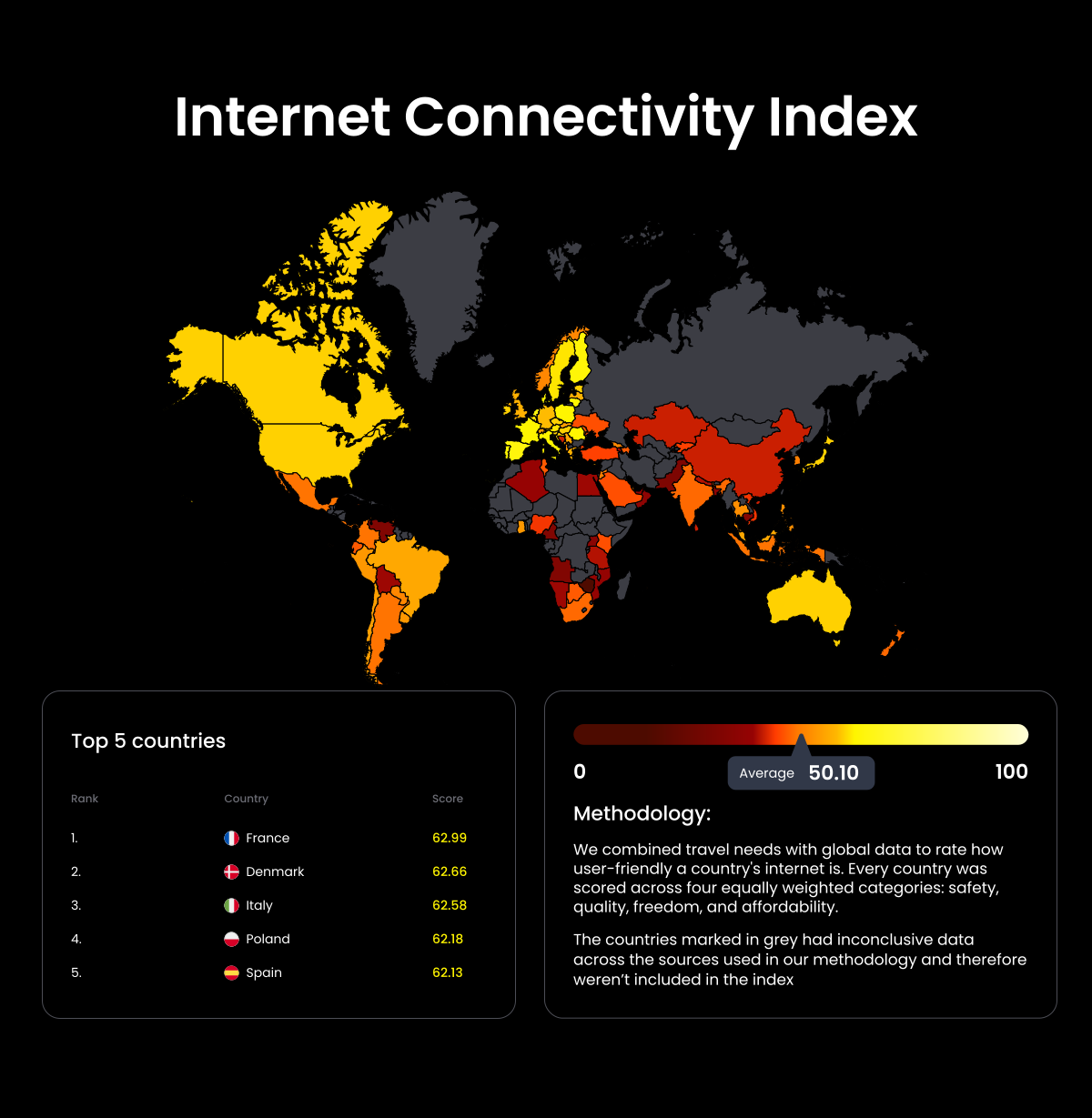
To navigate this fractured landscape, the Saily research team analyzed 96 destinations to create the Internet Connectivity Index. Rather than relying on a single metric like speed, the Index synthesizes four critical pillars — Safety, Quality, Freedom, and Affordability — into a single score.
The results expose a volatile global standard. While some nations offer a “digital utopia” of fast, open, and cheap internet, others force travelers into a triangle of trade-offs: sacrificing privacy for speed, or paying exorbitant rates for basic coverage. To quantify this experience, the Index evaluates four specific pressure points that can make or break a getaway:
Cyber safety in practice
A country with strong legal protections and reliable security frameworks significantly reduces the risk of data theft or fraud. For a traveler, this pillar is the difference between confidently booking a hotel on a public network and worrying about identity theft. Travelers navigating online payments, ticket purchases, or hotel confirmations benefit directly from these safeguards.
Internet quality during a trip
Speed is often the first thing people notice. A stable network ensures video calls work without interruption, uploads and downloads complete quickly, and apps stay responsive. This pillar is all about how smooth a trip feels. High scores here mean you can stream entertainment on a train ride or join a Zoom meeting from a cafe without the frustration of buffering or dropped signals.
Internet freedom while abroad
An open internet allows travelers to access their usual communication tools, social media platforms, and news sources. Limited freedom can disrupt daily routines and create extra steps for staying informed. In countries ranking high in internet freedom, you browse the web without restrictions. In low-ranking ones, you may find yourself blocked from WhatsApp, Instagram, or vital news outlets, forcing you to find workarounds just to stay in touch.
Affordability and its real impact
Mobile data costs shape how travelers use the internet. Affordable plans in high-ranking countries allow for frequent navigation checks, photo uploads, and video content streaming without concern. Expensive internet access in destinations ranking low requires more caution, forcing travelers to ration data or hunt for Wi-Fi.
By combining these metrics, the Index moves beyond simple speed tests to offer a holistic view of digital travel. It ensures that a destination isn’t just judged by how fast a page loads, but by whether a traveler can access the internet safely, freely, and affordably — creating a realistic profile of the digital friction they will face upon arrival.
The global winners: Europe’s digital seamlessness
When the data is aggregated, a clear “connectivity superpower” emerges. Five European nations claim the top spots, offering the world’s most frictionless online environments.
Top 5 countries in the Saily’s Internet Connectivity Index 2025:
France
Denmark
Italy
Poland
Spain
France secures the number one spot (combined score: 62.99/100), benefiting from years of investment in digital infrastructure and consumer protections. The government’s “New Deal Mobile” initiative, designed to eliminate rural “white zones,” accelerated coverage in regions that previously lagged behind and helped close the digital divide. France now delivers a rare trifecta: high speeds, strict EU-mandated consumer privacy laws, and a fiercely competitive telecom market that keeps prices among the lowest in Western Europe.
Poland (combined score: 62.18/100) and Spain (combined score: 62.13/100) stand out specifically for value. Poland, often citing some of the lowest mobile data costs in Central Europe, proves that world-class connectivity doesn’t require premium pricing. For digital nomads and long-term travelers, these markets represent the sweet spot of high quality and low overhead.
Europe’s dominance is no accident — it is the result of decades of regulatory integration. The standout performance of these nations reflects a broader EU philosophy where connectivity is treated as a consumer right rather than a premium service. For travelers, this turns connectivity from a logistical worry into a given.
The high cost of quality: The North American paradox
The United States and Canada present a stark contrast to Europe. In terms of raw Quality and Safety scores, they are world leaders. Infrastructure is robust, and cyber-defense mechanisms are sophisticated.
However, the Affordability pillar drags their overall ranking down significantly. Due to consolidated telecom markets (where a few major players control pricing), mobile data in North America remains among the most expensive in high-income countries. For visitors, this creates a pay-to-play environment: The connection will almost certainly work, but using it with the freedom one might enjoy in Poland or France comes at a significant premium.
The invisible wall: Where speed meets censorship
The Index highlights a concerning trend in parts of the Middle East and Asia — the rise of the “high-speed intranet.” Countries like the UAE and China boast some of the fastest technical infrastructure on the planet, yet they rank poorly in Freedom.
For the traveler, this creates a jarring experience. The connection is lightning fast, but the “global” internet is inaccessible. Without advanced preparation, travelers may find themselves cut off from WhatsApp, Gmail, or Western news sources, proving that bandwidth is useless if the digital destination is blocked.
The volatility of emerging markets
In regions across South Asia, Africa, and Latin America, the challenge is rarely a total lack of internet, but rather its inconsistency. The Index reveals that while data in countries like Bangladesh or Venezuela can be affordable, the Quality scores suffer due to frequent outages and limited bandwidth outside major or capital cities.
This creates an urban/rural divide. In the capital, 5G may be blazing fast, but moving just 20 kilometers out can result in a complete blackout. Here, technical preparation — such as downloading offline maps and having backup connectivity options — moves from a convenience to a necessity.
How Saily built the Internet Connectivity Index
The Index follows a transparent methodology that combines real travel needs with trusted global data. Saily’s research team drew on data from sources such as the ITU Global Cybersecurity Index, the GSMA Mobile Connectivity Index, and the Human Freedom Index. Whenever possible, the team used figures from 2024 and 2025 to keep the results current.
From this base, the team selected attributes that match the way people actually use the internet while traveling. These attributes were grouped into the four pillars of safety, quality, freedom, and affordability. Each pillar contributes one quarter of the final score. Inside each pillar, attributes are weighted according to their relevance for travelers.
Finally, every country’s performance was converted to a 0-100 scale. A score above 50 means a country performs better than the global average. A score below 50 indicates areas where travelers are more likely to encounter difficulty. This structure allows Saily to compare countries fairly and gives readers a clear way to interpret results at a glance.
The new border crossing
A single “global” internet is not a thing anymore. As travelers move across borders, they step into vastly different digital realities. The Saily Internet Connectivity Index serves as a navigational tool for this new terrain, allowing travelers to predict the reliability of their link to the outside world the same way they would check the weather or the exchange rates for their destination.
Before you board your next flight, explore the Index to see how your next destination ranks — and give yourself one less thing to worry about when you walk out of the airport.

Stay connected with the Saily eSIM app
Affordable mobile data plans for every journey.


Sur le même sujet
