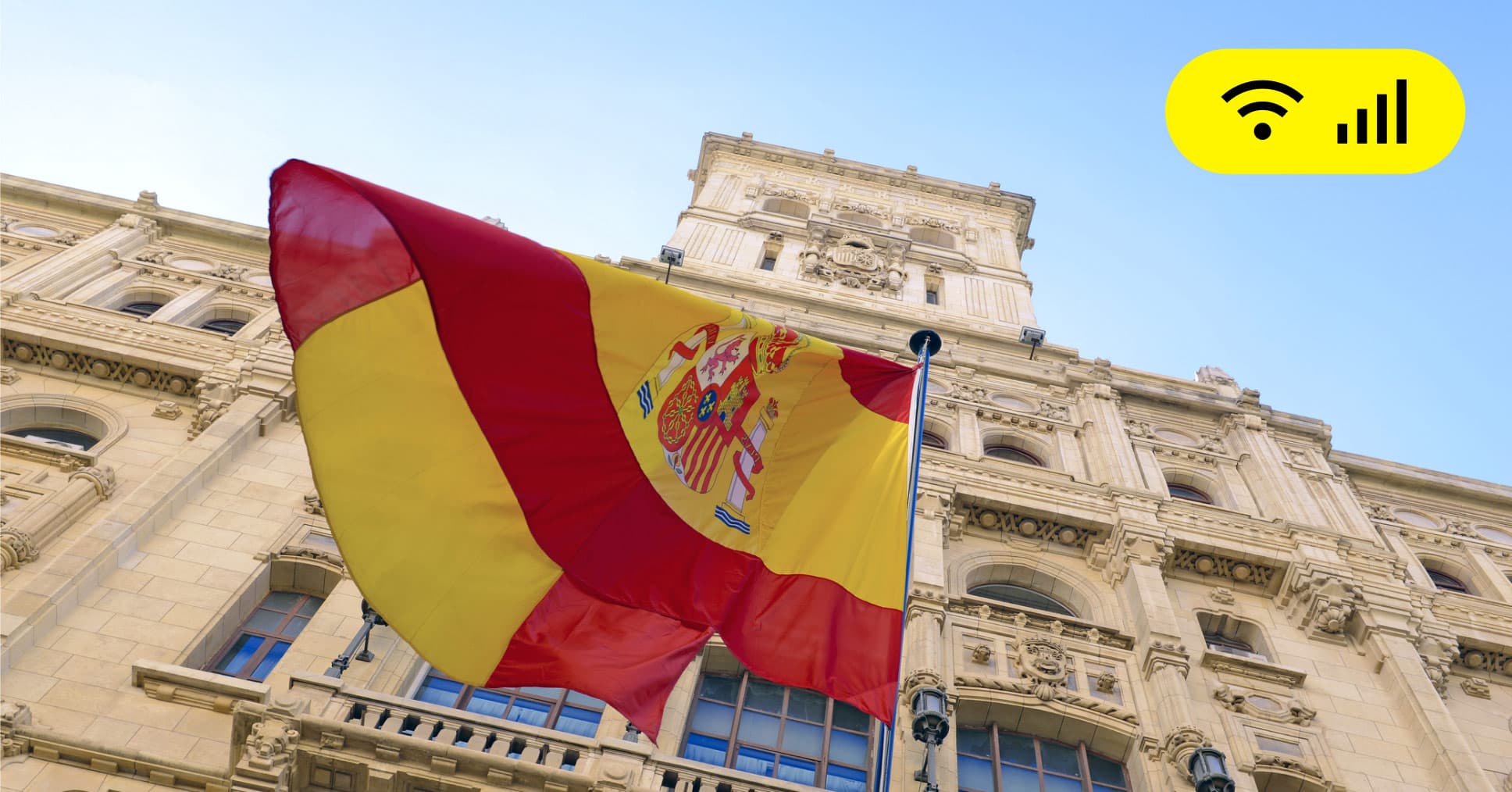
Is mobile internet good in Spain? What to expect
Spain has one of Europe’s most developed telecom markets, with widespread 4G and expanding 5G coverage across cities and major transport routes. In large cities like Madrid, Barcelona, Valencia, and Seville, 5G is widely available in areas such as transport hubs, shopping centers, and many metro stations.
The main networks are Movistar, Orange and Yoigo/MásMóvil within the MasOrange group, and Vodafone, with DIGI emerging as a fourth competitor. Most travel eSIMs connect through one or more of these Spanish networks.
Speeds are generally fast enough for maps, messaging, streaming, remote work, and video calls, with Movistar leading recent overall download-speed testing.
Nationwide plans also work across the Balearic Islands, including Mallorca and Ibiza, and the Canary Islands, including Tenerife and Lanzarote. Coverage is dependable in most towns and tourist areas, although the ability to connect at remote beaches, along mountain routes, and on isolated inland locations can still have occasional gaps. The right option really depends on your trip length, device, and preferred level of convenience.
Best mobile internet options in Spain by cost and convenience
To stay connected, you can choose between an eSIM, local prepaid SIM, roaming, pocket Wi-Fi, and public Wi-Fi. The following options are ordered broadly from the most convenient for an individual traveler to the least dependable as a primary connection.
1. Use an eSIM — fast, flexible, and working on arrival
An eSIM is a digital SIM built into a compatible phone. Instead of inserting a physical card, you choose a mobile data plan online and install it through an app or by scanning a QR code.
For most short trips, an eSIM is one of the easiest ways to get mobile internet in Spain. You can set it up while you still have a reliable internet connection at home, then connect when you arrive without visiting a phone shop or registering a local SIM card with your passport. It also lets you keep your usual SIM in your phone, so you can continue receiving calls and messages on your home number while using the eSIM for mobile data — just make sure mobile data and data roaming are turned off for your home SIM to avoid accidental charges.
Most iPhones from the XS, XS Max, and XR onwards support eSIM technology, as do many newer Samsung Galaxy and Google Pixel models, but compatibility can vary by device and country of purchase. Check that your phone supports eSIM technology and is unlocked before choosing a plan.
With a Saily eSIM for Spain, you also get in-app top-ups, hotspot sharing, and built-in security features such as web protection, an ad blocker, and virtual location. If you’re planning a multi-country trip, a regional European plan can even cover you across other countries, such as Portugal, France, and Italy.
Pros:

Offers quick online setup before departure.
Keeps your home SIM and number active.
Suits both Spain-only and multi-country trips.
Cons:

Requires an unlocked, compatible phone.
Needs an internet connection for setup.
You can read more about the benefits of an eSIM or compare an eSIM with a physical SIM before deciding.
2. Buy a local SIM card — good for long stays
A prepaid SIM card for Spain can be a cost-effective option if you’re staying for several weeks or want a Spanish phone number for local calls. The main providers are Movistar, Orange, and Vodafone, while Yoigo and DIGI offer lower-cost alternatives. You can buy SIM cards at carrier stores, at kiosks in major airports, from authorized dealers, and in some estancos or convenience stores.
Current prepaid packages commonly cost around €7-10 for 50-100 GB, while plans priced at approximately €15-20 may include several hundred gigabytes. Offers change frequently, however, and promotional allowances may apply only for a limited period or change when the plan renews.
Spanish law requires prepaid customers to register with an accepted identity document, such as a passport or national ID card. This can slow the process at a busy counter, and you may also need to remove or deactivate your usual SIM unless your phone supports dual SIM.
Movistar is generally the safest all-around network choice, particularly for rural and inland travel. Orange performs strongly in cities, coastal areas, and tourist destinations, while Vodafone is a solid option for city-heavy trips. For an ordinary city break, however, the difference between the major networks is unlikely to be dramatic.
Pros:
Offers generous data allowances at competitive prices.
Provides a Spanish phone number.
Offers good value for longer stays.
Cons:
Requires passport or ID registration.
Means finding a retailer after arrival.
Can come with confusing promotional conditions.
3. Use roaming — easy for short trips
Data roaming lets your home provider connect your phone to a Spanish partner network. You keep your usual SIM, phone number, and plan, but the cost depends heavily on where your contract is based.
Travelers with an eligible EU or European Economic Area plan can usually use their domestic calls, texts, and data allowance in Spain at no extra charge under the EU’s “Roam Like at Home” regulations. Fair-use limits can still apply.
Some UK networks include Spain on selected plans, while others charge a daily rate or require an international plan or roaming add-on. Travelers from the US, Canada, Australia, and other non-EU countries may face much higher charges.
Compare the potential international roaming costs from two major US providers:
Provider | Example roaming cost in Spain | Data |
|---|
AT&T | US$12 per 24 hours | Domestic plan allowance on eligible plans |
|---|
Verizon | US$12 per 24 hours | 5 GB of high-speed data, followed by reduced speeds |
|---|
Using either day pass throughout a seven-day trip would cost US$84. Using roaming may be reasonable if you only need mobile data for one day, but for the full trip, it’s usually less cost-effective than arranging an eSIM or local SIM. Most phones will connect to Spanish networks if they support the necessary bands and your provider has a roaming agreement. Check whether your phone will work in Spain before departure.
You’ll generally need to enable data roaming to use your home SIM for mobile data. Remember that automatic app updates, photo backups, and email syncing can use roaming data in the background and activate a daily roaming charge, even when you aren’t actively using your phone.
Pros:
Lets you use your existing SIM and phone number.
Connects automatically on arrival.
Comes included with eligible EU or EEA plans.
Cons:
Costs more for many non-EU travelers.
Imposes data limits or reduced speeds.
Triggers daily charges through background activity.
Roaming is convenient for a very short trip, particularly when it’s already included in your plan. You can also learn how to use your phone overseas without roaming if you want to avoid these charges.
4. Rent pocket Wi-Fi — best for groups or families
A pocket Wi-Fi device is a portable router that connects to a mobile network and shares internet access with multiple devices. You rent the device for your trip, collect it or have it delivered, and return it afterward.
Prices often start at around US$4.50-12 per day, although shorter bookings, 5G service, delivery, insurance, and other extras can increase the total cost.
Some devices support up to 10 simultaneous connections, making pocket Wi-Fi practical for families, groups, or travelers carrying several devices. It can also help when one or more phones don’t support eSIM technology.
The main drawback is carrying and charging an extra device, and its battery may not last all day. All users lose the connection if the battery runs out or the person carrying it walks away, and deposits or replacement fees can be high.
Pros:
Connects multiple people and devices.
Doesn’t require changing your phone’s SIM.
Supports devices without eSIM technology.
Cons:
Must be carried and charged.
Requires advance planning for delivery and returns.
May come with deposits or replacement fees.
5. Connect to public Wi-Fi
Free Wi-Fi hotspots are widely available at Spanish airports, train stations, hotels, cafés, restaurants, shopping centers, libraries, and other public buildings. Some cities also operate municipal networks in selected parks, squares, public transport services, and community facilities.
Public Wi-Fi can help you check an address, download a ticket, or send a quick message. However, some networks require registration, impose time limits, or slow down when many people connect. Access also becomes less predictable away from cities and tourist centers.
Open networks might not fully encrypt your traffic, so they’re better used as a backup than as your main connection. You should avoid using them for online banking, shopping, or sensitive accounts. To be on the safe side, confirm the correct network name with staff, use a trusted VPN, and take advantage of security tools such as Saily’s web protection and ad blocker.
Pros:
Can be widely available in cities and tourist areas.
Works well for quick, low-data tasks.
Cons:
Varies in speeds and reliability.
May come with registration or time limits.
Can expose you to security risks on open networks.
Mobile network coverage and speeds across Spain
Spain’s major mobile networks provide extensive 4G coverage and increasingly widespread 5G service. Coverage percentages usually refer to the share of the population reached rather than the amount of land covered, so gaps in remote areas can remain even when an operator reports high nationwide coverage.
Independent testing broadly points to Movistar as Spain’s strongest all-around network. Opensignal’s April 2026 report named it Spain’s Best Network and placed it first for overall download speed, consistent quality, and reliability. Ookla’s H1 2025 Speedtest Connectivity Report reached a similar conclusion, ranking Movistar as Spain’s best overall mobile network and best 5G network. While DIGI recorded the fastest raw 5G download speeds in testing, Movistar’s broader reach and consistent performance make it the safest choice for most travelers.
The table below combines Opensignal’s latest 5G speed results with recent coverage information published by the operators. These figures are averages rather than guaranteed speeds, and your experience will depend on your location, device, plan, and network congestion.
Operator | Latest coverage snapshot | Average 5G download speed | Best for |
|---|
Movistar (Telefónica) | More than 95% of the population and over 6,200 municipalities | 241.7 Mbps | Strong all-around performance and broad rural reach |
|---|
Orange (MasOrange) | More than 93% of the population and over 4,000 municipalities | 180.4 Mbps | Cities, coastal areas, and tourist destinations |
|---|
Yoigo (MasOrange) | Uses the wider MasOrange network footprint | 160.1 Mbps | Urban coverage and competitively priced local plans |
|---|
Vodafone | More than 90% of the population and over 4,100 municipalities | 122.9 Mbps | Cities and expanding rural coverage |
|---|
DIGI | Uses its own infrastructure alongside a network agreement with Telefónica | 260.4 Mbps | Budget-conscious users and fast 5G where available |
|---|
These figures aren’t a guarantee that one provider will always perform best. You should check the provider’s coverage map for the specific destinations you plan to visit, particularly when traveling through rural or mountainous areas.
Mobile internet in rural areas of Spain
Mobile coverage is generally dependable in towns, coastal resorts, and populated rural areas, but signals can become weaker in mountainous or sparsely populated parts of the country. You may encounter gaps in sections of the Pyrenees, inland Andalusia, remote sierras, national parks, and isolated villages.
Spain’s providers are continuing to expand 5G beyond the largest cities. Movistar now covers more than 6,200 municipalities, MasOrange has brought 5G to almost 4,500 towns with fewer than 10,000 residents, and Vodafone has also extended its network across thousands of smaller municipalities.
Even so, it’s sensible to download offline maps, tickets, accommodation details, and important contact information before driving or hiking through remote areas. When choosing an eSIM, look for one that uses established Spanish networks. Saily provides reliable connectivity through local network providers, although the quality of your signal will still depend on coverage in your location.
Mobile internet speeds and reliability in Spanish cities
In Madrid, Barcelona, Valencia, Seville, Málaga, and other major cities, you can usually expect strong 4G or 5G service suitable for maps, streaming, video calls, and remote work. Coverage is also widely available in shopping centers, transport hubs, and many metro stations, although tunnels and underground sections may occasionally interrupt the signal.
Networks can become busier in crowded tourist areas, at festivals, and in coastal resorts during the summer. This could temporarily reduce speeds, particularly at peak times, but mobile data will usually be more consistent than free public Wi-Fi.
If Barcelona is your main destination, you can also compare options for getting an eSIM for Barcelona.
How to use your phone in Spain
Most unlocked smartphones from the US, UK, and other countries will work in Spain. Spanish mobile networks use widely supported GSM, 4G LTE, and 5G technology, although compatibility can still depend on your phone model and the frequency bands it supports.
Before traveling, check that your phone is unlocked and compatible with your chosen eSIM or Spanish SIM card. A locked device may only accept service from your home provider, leaving international roaming as your main option.
Apps such as WhatsApp, FaceTime, and Zoom work over mobile data or Wi-Fi, making them an inexpensive way to call or message people at home. Using these apps will consume data, but it usually costs less than making conventional international calls through your mobile provider.
If your phone supports dual SIM, you can keep your home SIM active for calls and incoming SMS, including verification codes, while using an eSIM for mobile data. Set the eSIM as your preferred mobile data line, then switch off data roaming and automatic data switching for your home SIM to help prevent unexpected charges.
Staying connected across multiple European countries
Trips to Spain often expand into multi-country itineraries that include destinations like Portugal, France, and Italy. A regional eSIM can keep you connected across several countries using one plan, removing the need to buy and install a separate SIM each time you cross a border.
Saily’s regional Europe plan covers Spain and numerous other European destinations and activates when you arrive in the first included country. You can also top up through the app if you need more data during your trip.
A country-specific Saily plan for Spain only works within Spain, so choose a regional plan at the outset if you’ll be traveling further. Spanish prepaid SIM cards may include roaming within the EU and EEA, subject to the provider’s fair-use limits, but destinations outside those arrangements can attract additional charges. Check the included countries and roaming terms before relying on a local plan for the whole trip.
How much does mobile internet cost in Spain? Price comparison
The cost of mobile data in Spain depends on the connection method, length of your trip, and amount of data you need. A local SIM may give you the lowest daily cost for a longer stay, while an eSIM usually provides the best balance of convenience and value.
Option | Estimated cost per day | Setup | Secure | Best for |
|---|
eSIM | Approx. US$0.30-2 | Usually automatic | Yes | Very short trips |
|---|
International roaming | US$10-12 with a typical US day pass | Usually automatic | Yes | Very short trips |
|---|
Local SIM card | Approx. US$0.30-0.85 | Requires purchase and ID registration | Yes | Longer stays or a local number |
|---|
Pocket Wi-Fi | Approx. US$4.50-12 | Delivery or collection required | Yes, when password-protected | Groups and families |
|---|
Public Wi-Fi | Free | Connect and sometimes register | Not always | Occasional backup use |
|---|
These figures are approximate. The final cost will depend on the provider, plan duration, data allowance, exchange rate, and any delivery, activation, or equipment charges.
An eSIM may not always have the lowest headline price, but it avoids the time and inconvenience of finding a shop, registering a physical SIM, or returning rented equipment. International roaming is the easiest option for a single day, but daily charges can make it considerably more expensive over a longer trip.
How much data do you need for your trip to Spain?
The right data allowance depends on how long you’ll be away and what you plan to do online. You can use Saily’s data usage calculator to estimate your needs based on activities such as browsing, navigation, social media, streaming, and video calls.
As a general guide:
Between 1 and 3 GB may be enough for a short trip with light use, such as messaging, checking bookings, and occasional maps.
Around 5 GB should be enough if you are spending up to two weeks in Spain and regularly using maps, browsing, messaging, and social media.
A range of 10-20 GB is more suitable if you stream music or video, make video calls, work remotely, or share your connection with another device.
Unlimited data is useful for heavy users who don’t want to monitor their remaining allowance.
Saily offers Spain plans ranging from 1 GB to 20 GB, along with unlimited options. However, unlimited internet access may still be subject to daily fair-use limits. Saily’s current unlimited plans provide 5 GB of full-speed data every 24 hours, after which speeds may be reduced until the daily allowance resets. Check the plan details before buying because fair-use conditions can vary.
Make your allowance last longer by downloading maps, playlists, and entertainment over Wi-Fi before heading out, lowering streaming quality, and turning off automatic app updates and cloud backups while using mobile data.
What’s the best option for you?
An eSIM offers the best combination of convenience, flexibility, and predictable pricing. You can arrange your mobile data before departure, connect soon after landing, and keep your usual SIM in your phone without searching for a shop or registering a physical card.
The other options may suit particular trips:
Use EU roaming if it’s already included in your home plan and your trip is short.
Buy a local SIM card if you’re staying for several weeks or need a Spanish phone number.
Rent pocket Wi-Fi if a family or group needs to connect several devices through one plan.
Use international roaming if convenience matters more than cost and you only need it briefly.
Connect to public Wi-Fi for occasional browsing, but don’t rely on it for continuous or sensitive use.
Saily offers mobile data plans in more than 200 destinations, making it useful for future trips as well as visits to Spain. For a journey covering several European countries, choose a regional Europe plan rather than buying a separate country plan each time you cross a border.
Ready to stay connected in Spain? Choose your data allowance, install your eSIM before departure, and activate it when you arrive. Visit the Saily eSIM for Spain page to compare available plans or download the Saily eSIM app to get started.