FIFA World Cup 2026™ stadiums and their information
The World Cup™ returns in 2026 with a geographic ambition the tournament has never attempted before. Matches will unfold across three countries: the United States, Canada, and Mexico. Air routes and 16 stadiums in four different time zones will stitch the tournament together. Fans will move from high-altitude Mexico City to climate-sealed domes in Texas. They will travel from the Pacific Northwest's open-air venues, where rain can become an important factor in the match, to indoor stadiums on Canada's west coast. Some venues carry decades of soccer history. Other stadiums were designed for American football and repurposed for a global game that demands wider pitches and natural grass. In every case, the stadiums will play a defined role in the tournament's arc and shape how matches will feel and sound.
Table of Contents
- List of 2026 World Cup host stadiums
- AT&T Stadium, Dallas (Arlington, Texas)
- Estadio Banorte, Mexico City
- MetLife Stadium, New York/New Jersey (East Rutherford, New Jersey)
- Mercedes-Benz Stadium, Atlanta
- GEHA Field at Arrowhead Stadium, Kansas City
- NRG Stadium, Houston
- Levi's Stadium, San Francisco Bay Area (Santa Clara, California)
- SoFi Stadium, Los Angeles (Inglewood, California)
- Lincoln Financial Field, Philadelphia
- Lumen Field, Seattle
- Gillette Stadium, Boston (Foxborough, Massachusetts)
- Hard Rock Stadium, Miami (Miami Gardens, Florida)
- BC Place, Vancouver
- Estadio BBVA, Monterrey (Guadalupe)
- Estadio Akron, Guadalajara (Zapopan)
- BMO Field, Toronto
- What is the stadium for the FIFA World Cup 2026™ final?
- What are the FIFA World Cup 2026™ semifinal stadiums?
- AT&T Stadium, Dallas (Arlington, Texas)
- Mercedes-Benz Stadium, Atlanta
- Navigating a continent-sized tournament
List of 2026 World Cup host stadiums
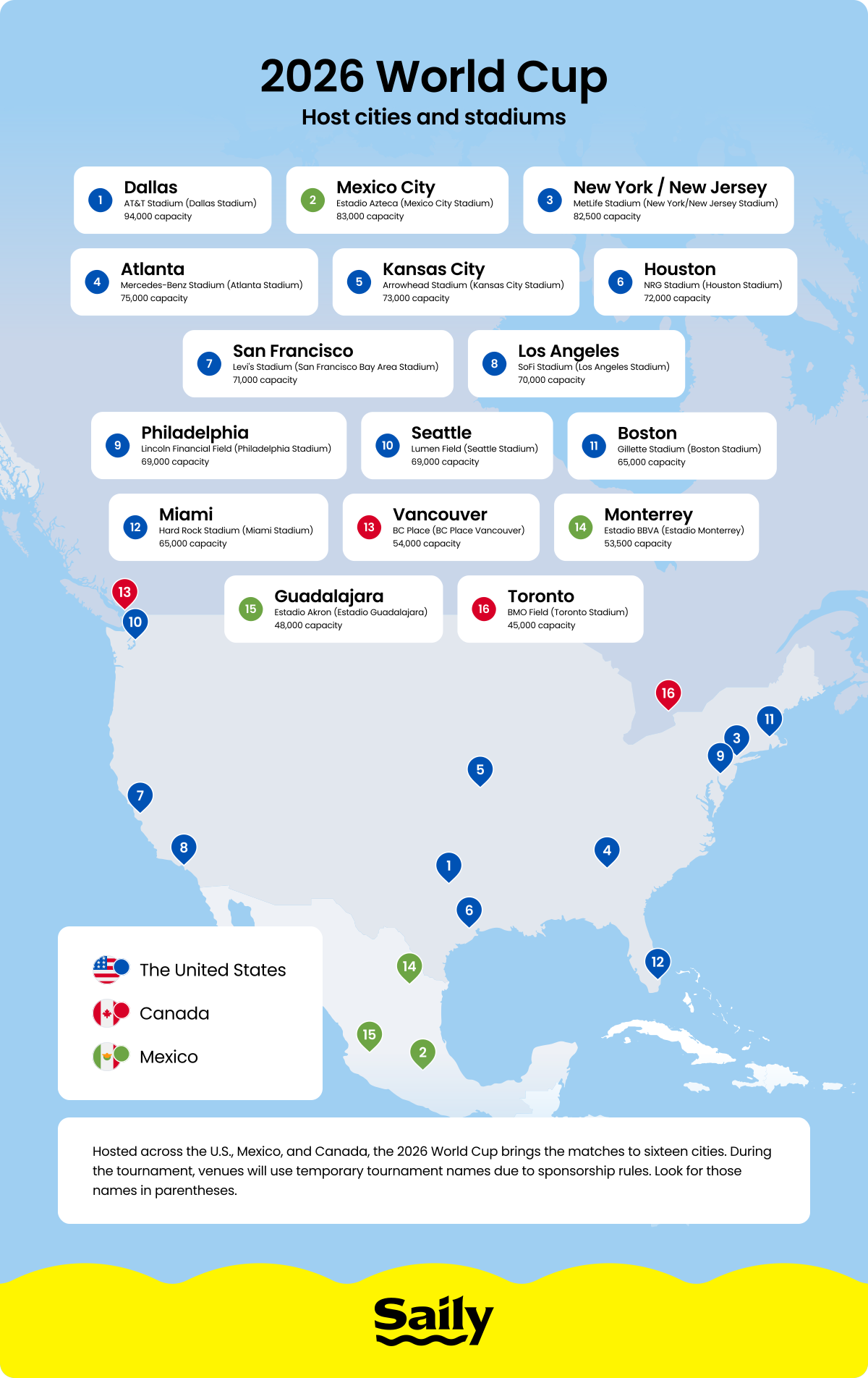
The sixteen stadiums listed below (from the largest-capacity stadium to the smallest) serve as the physical anchors for the 2026 World Cup, tasked with containing an event whose last finale drew 1.42 billion viewers. These venues are built for mass attendance, but they will exhibit a specific quirk during the tournament: FIFA® will scrub all corporate branding from the official World Cup™ schedule. This creates a potential disconnect where your ticket might list “Dallas Stadium” while your navigation app may point to “AT&T Stadium.” To bridge that gap, the stadium profiles below identify the neutral tournament names alongside their local titles, ensuring the destination on your screen matches the one on your ticket.
AT&T Stadium, Dallas (Arlington, Texas)
2026 World Cup name: Dallas Stadium
Capacity: 94,000
The structure dominates the flat landscape of Arlington, a suburban anchor between Dallas and Fort Worth. Inside, the seating bowl rises steeply, stacking fans close to the field in a way that amplifies noise. The retractable roof ensures weather will not dictate the conditions of play, a crucial factor for the nine matches scheduled here. The venue will host five group games and four knockout rounds, including a semi-final on July 14, 2026.
Estadio Banorte, Mexico City
2026 World Cup name: Mexico City Stadium
Capacity: 83,000
Estadio Azteca, currently under the Banorte name for renovation purposes, carries a weight of history few modern stadiums can match. The venue stands as the first stadium to host three World Cup™ opening matches, a record it will set on June 11, 2026, when Mexico faces South Africa. The renovation aims to modernize the facilities without erasing the concrete brutalism that defines its character. High altitude plays a role here — the stadium sits about 7,300 feet above sea level — forcing visiting teams to adapt their lungs as much as their tactics.
MetLife Stadium, New York/New Jersey (East Rutherford, New Jersey)
2026 World Cup name: New York/New Jersey Stadium
Capacity: 82,500
MetLife Stadium occupies the Meadowlands, a reclaimed marshland visible from the Manhattan skyline. The venue lacks a roof, leaving it open to the humidity of an East Coast summer. It will serve as the tournament’s primary stage, hosting eight matches, including the World Cup™ final on July 19, 2026. The utilitarian design favors sightlines over architectural flair, a choice that maximizes capacity for the event’s most significant fixture.
Mercedes-Benz Stadium, Atlanta
2026 World Cup name: Atlanta Stadium
Capacity: 75,000
Mercedes-Benz Stadium breaks from traditional bowl design with an ocular roof that opens and closes like a camera aperture. A circular “halo” video board rims the roof opening, ensuring replays and statistics remain visible from any seat. The venue will host eight matches, including a semi-final on July 15, 2026. The artificial surface typically used here will be replaced with natural grass for the tournament, a mandatory conversion for compliance.
GEHA Field at Arrowhead Stadium, Kansas City
2026 World Cup name: Kansas City Stadium
Capacity: 73,000
Arrowhead Stadium has a reputation for acoustic intensity. The open-air bowl captures crowd noise and directs it onto the field, a phenomenon that has registered 142.2 decibels during American football games. The stadium will host six matches, including a quarter-final on July 11, 2026. Its location outside the city center requires specific transport planning, but the atmosphere inside often justifies the logistical effort.
NRG Stadium, Houston
2026 World Cup name: Houston Stadium
Capacity: 72,000
NRG Stadium introduced the retractable roof concept to the NFL, a design necessity for Houston’s heat and humidity. The roof will likely remain closed for the seven matches scheduled here, shielding players and 72,000 spectators from the Texas sun. The venue will host a pivotal Round of 16 match, acting as a climate-controlled bridge between the group stages and the later knockout rounds.
Levi's Stadium, San Francisco Bay Area (Santa Clara, California)
2026 World Cup name: San Francisco Bay Area Stadium
Capacity: 71,000
Levi’s Stadium marks the center of the Silicon Valley tech corridor in Santa Clara, forty miles south of San Francisco. The open design takes advantage of the dry California climate, though the sun can be intense on the east side of the stadium during afternoon kickoffs. The venue will host six matches, including a Round of 32 fixture on July 1, 2026. Qatar faces Switzerland here on June 13, bringing international focus to a stadium known primarily for its high-tech infrastructure.
SoFi Stadium, Los Angeles (Inglewood, California)
2026 World Cup name: Los Angeles Stadium
Capacity: 70,000
SoFi Stadium represents the most expensive sports venue ever built (some estimates put the build cost in the range of US$5B), a sunken bowl covered by a translucent canopy that allows natural light while blocking direct sun. Located in Inglewood, near LAX airport, the stadium features a dual-sided video board that hangs over the field. It will host eight matches, including the United States’ opening game on June 12 and a quarter-final. The design integrates the stadium into a larger entertainment district, blurring the line between the venue and its surroundings.
Lincoln Financial Field, Philadelphia
2026 World Cup name: Philadelphia Stadium
Capacity: 69,000
Lincoln Financial Field anchors South Philadelphia’s sports complex, a dedicated zone of stadiums and arenas. The venue features open corners that allow views of the city skyline, connecting the action on the field to its urban context. It will host six matches, including a Round of 16 match on July 4, 2026 — a date that aligns the knockout fixture with the United States’ 250th independence anniversary.
Lumen Field, Seattle
2026 World Cup name: Seattle Stadium
Capacity: 69,000
Lumen Field uses two massive parabolic roof arches to cover the grandstands while leaving the field open to the elements. The design reflects sound back toward the pitch, creating an environment that opposing teams often find disorienting. The venue will host six matches, including a Round of 16 fixture. Seattle’s northern latitude ensures long daylight hours during the tournament window, adding a distinct visual quality to evening matches.
Gillette Stadium, Boston (Foxborough, Massachusetts)
2026 World Cup name: Boston Stadium
Capacity: 65,000
Gillette Stadium stands in Foxborough, a midway point between Boston and Providence. The stadium’s open end frames a view of the surrounding New England landscape, a deliberate break from the enclosed concrete bowls of earlier eras. It will host seven matches, concluding with a quarter-final on July 9, 2026. The location demands reliance on commuter rail or private vehicles, a factor for travelers to consider.
Hard Rock Stadium, Miami (Miami Gardens, Florida)
2026 World Cup name: Miami Stadium
Capacity: 65,000
Hard Rock Stadium features a large rectangular canopy added during a major renovation to shade spectators from the South Florida sun. The roof covers the seating bowl but leaves the pitch exposed. The venue will host seven matches, including the Bronze Final (match for third place). The third-place match will put a global spotlight on the stadium.
BC Place, Vancouver
2026 World Cup name: BC Place Vancouver
Capacity: 54,000
BC Place defines the Vancouver skyline with a retractable roof supported by a web of cables. The interior offers a controlled environment, immune to the coastal rain that characterizes the region. The stadium will host seven matches, including two Canadian national team group games. Situated downtown, the venue lies within walking distance of the city center, a rarity among North American host venues.
Estadio BBVA, Monterrey (Guadalupe)
2026 World Cup name: Estadio Monterrey
Capacity: 53,500
Estadio BBVA is often noted for its backdrop — the jagged silhouette of Cerro de la Silla mountain is visible through the stadium’s open structure. The design of the stadium emphasizes spectator proximity to the pitch, ensuring the crowd’s energy transfers directly to the players. It will host four group-stage matches. One of them signifies a major milestone: Tunisia vs Japan will be the 1,000th match in World Cup™ history.
Estadio Akron, Guadalajara (Zapopan)
2026 World Cup name: Estadio Guadalajara
Capacity: 48,000
Estadio Akron is built into a raised earth berm, designed to resemble a volcano blending into the landscape. The white roof cloud hovers over the seating bowl, providing shade and visual lightness. The stadium will host four group-stage matches, including Mexico vs. South Korea on June 18, 2026. Guadalajara’s history as a host city for the World Cup™ in 1970 and 1986 adds a layer of legacy to these fixtures.
BMO Field, Toronto
2026 World Cup name: Toronto Stadium
Capacity: 45,000
BMO Field is the smallest venue in the 2026 rotation, though temporary seating will expand its capacity for the tournament. The open-air stadium stands on the Exhibition Place grounds near the shore of Lake Ontario. It will host six matches, including Canada’s opening game on June 12, 2026. The compact size can create a sharper, more focused acoustic environment than the cavernous NFL stadiums used elsewhere.
What is the stadium for the FIFA World Cup 2026™ final?
The 2026 World Cup culminates at MetLife Stadium, a concrete leviathan constructed on the marshlands of East Rutherford, New Jersey. On July 19, 2026, the open-air venue will hold 82,500 spectators for the championship match, operating under the neutral FIFA® title “New York New Jersey Stadium.” The selection places the tournament’s deciding moments in the humidity of an East Coast summer, on a natural grass surface installed specifically for this final encounter.
What are the FIFA World Cup 2026™ semifinal stadiums?
The penultimate round of the tournament will shift the focus to two of the most technically advanced venues in the United States. While the quarterfinal matches scatter across the continent, the pathway to the final will narrow to two retractable-roof stadiums in the American South. This strategic choice ensures that the intense July humidity of Texas and Georgia plays no role in determining the finalists.
AT&T Stadium, Dallas (Arlington, Texas)
Dallas Stadium will host the first semifinal on July 14, 2026. While the venue’s sheer scale defines its group-stage role, the retractable roof becomes the critical feature for a mid-July knockout fixture. The climate-controlled environment guarantees that the heat of North Texas remains an external factor, not a playing condition.
Mercedes-Benz Stadium, Atlanta
Atlanta Stadium will secure the second semifinal on July 15, 2026. The match will conclude a run of eight fixtures played in the city, marking the end of the tournament’s presence in the region. The stadium typically uses artificial turf, but for this match, a temporary natural grass field will be installed to meet FIFA® regulations.
Navigating a continent-sized tournament
The 2026 World Cup will force a recalibration of what it means to attend a major sporting event. Previous tournaments let fans move between host cities by rail or short flights. The North American edition will span four time zones and three nations, turning a group-stage journey into a transcontinental haul. A supporter following a team from Vancouver to a knockout match in Miami could be looking at a flight of nearly 3,000 miles.
The logistical challenge will extend beyond geography. As stadiums shed their corporate names for generic FIFA® titles, travelers must align their digital tools with physical reality. Connectivity will become as vital as the match ticket. Downloading the Saily eSIM app and purchasing data plans will help ensure a connection that bridges borders. With a single eSIM profile, travelers can add data plans for the United States, Canada, and Mexico without hunting for SIM cards between flights. Whether navigating the high altitude of Mexico City or coordinating transport to a stadium miles from the city center, preparation will determine your experience.
The wordmark FIFA® and other wordmarks displayed are for illustration purposes only. Saily is not affiliated with, sponsored by, or endorsed by their owners.
Need data in North America? Get an eSIM!

1 GB
7 days
US$5.99
2 GB
15 days
US$11.49
3 GB
30 days
US$15.99
FAQ
The information we've provided is correct at the time of posting. Please check official sources and local alerts for the latest updates before and during your trip.

Stay connected with the Saily eSIM app
Affordable mobile data plans for every journey.