Why do digital nomads choose Turkey?
Turkey is a great fit for digital nomads thanks to its low cost of living, warm weather, reliable infrastructure, and rich culture. Its location between Europe and Asia also makes it easy to reach for remote workers from different countries, and the official digital nomad visa just adds to the draw.
Some of the biggest benefits of being a digital nomad in Turkey include:

Relatively low cost of living. Turkey is more affordable than many Western European and North American countries, especially outside central Istanbul and popular coastal areas.
A convenient location. Turkey sits between Europe and Asia, making it a strategic base for global work. Its UTC+3 time zone offers a perfect afternoon overlap with Europe and an evening window for US East Coast clients. Plus, as a major aviation hub, Istanbul puts dozens of countries within a short three-hour flight.
Varied destinations. The country features a variety of destinations to suit different tastes. Istanbul and Antalya provide a fast-paced urban lifestyle, while Izmir, Bodrum, and Fethiye are better suited to a more relaxed coastal routine.
Remote work-friendly infrastructure. Turkey is well set up for remote work, especially in major cities and tourist areas. You can usually find coworking spaces, laptop-friendly cafés, short-term rentals, and reliable mobile data options. To stay connected from the moment you land, you can set up a Saily eSIM for Turkey before you leave home so you have data ready for work and travel as soon as you arrive.
A defined digital nomad visa route. Eligible applicants first apply for a Digital Nomad Identification Certificate, then use it to apply for the relevant visa through a Turkish visa center or consulate. This two-step process gives remote workers a clearer and more structured way to relocate legally, which makes it easier to plan a longer stay.
Turkey digital nomad visa explained
The digital nomad route is a multi-step process rather than a single application. The process starts with obtaining Turkey’s Digital Nomad Identification Certificate (opens in a new tab), which confirms that you meet the established digital nomad criteria. If approved, you use it to apply for the relevant visa through a Turkish visa center or consulate. That said, the certificate doesn’t automatically guarantee visa approval, entry, or a residence permit, so check the latest instructions before making firm plans.
| Turkey digital nomad visa 2026 |
|---|
Who it’s for | Remote employees, freelancers, and self-employed workers earning income from outside Turkey |
|---|
Work allowed | Remote work for non-Turkish employers or foreign clients only |
|---|
Eligible age | 21 to 55 |
|---|
Income | Minimum US$3,000 per month (US$36,000 per year) |
|---|
Education | A university degree or equivalent |
|---|
Criminal record | A police clearance certificate required |
|---|
Health insurance | International health insurance with minimum coverage of around US$30,000 |
|---|
Stay duration | Official guidance does not clearly state a standard duration for the digital nomad visa itself. If you want to stay in Turkey for more than 90 days, you will usually need to apply for a short-term residence permit, which is often granted for up to one year. |
|---|
Family members | Not automatically covered; family members may need to apply for separate visas or residence permits |
|---|
First step | An online application for a Digital Nomad Identification Certificate |
|---|
Main extra costs | Visa and residence permit fees, international health insurance, document translations, notarization, photos, and document copies |
|---|
Who is eligible for the Turkey digital nomad visa?
To apply, you need to be from one of the eligible countries and meet the remote work, income, age, passport, and education requirements. The program is aimed at people who can support themselves with foreign income while living temporarily in Turkey.
According to the official GoTürkiye Digital Nomad platform (opens in a new tab), eligible countries currently include France, Germany, Italy, Belgium, the Netherlands, Luxembourg, Ireland, Denmark, Greece, Croatia, Spain, Portugal, Austria, Finland, Sweden, the Czech Republic, Hungary, Poland, Slovenia, Slovakia, Estonia, Latvia, Lithuania, Malta, Bulgaria, Romania, Norway, Iceland, Liechtenstein, the United Kingdom, Switzerland, the USA, Canada, the Russian Federation, Ukraine, and Belarus.
Foreigners from countries that aren’t on the list will need to consider another visa or residence route.
What are the requirements for the Turkey digital nomad visa?
To qualify for the Turkish digital nomad visa, you need to meet several personal, professional, and financial requirements. The main Turkey digital nomad visa requirements in 2026 are:

An eligible nationality. You must be a citizen of one of the countries listed under Turkey’s digital nomad program.
An age between 21 and 55. You must fall within this age range to qualify for the program.
A valid passport. Your passport or travel document should be valid for at least six months from your arrival date in Turkey.
University education. You’ll need to prove that you have graduated from a university.
A remote work arrangement. You must work remotely for a company outside Turkey or be self-employed with foreign clients.
An income of at least US$3,000 per month. Alternatively, you can prove an annual income of at least US$36,000.
A clean criminal record. You need a police clearance certificate from your country of residence, which may need to be apostilled.
An international health insurance policy. You will need proof of coverage for at least US$30,000, valid for the duration of your stay in Turkey.
It’s best to keep an eye on the official GoTürkiye platform before preparing your documents because visa and residence rules can change.
What documents are required for the Turkey digital nomad visa?
For the Digital Nomad Identification Certificate, you will need to upload scanned copies of the following documents:
A passport or travel document valid for at least six months from your date of arrival.
A university diploma or degree certificate as proof of your education.
Proof of remote work, such as an employment or business contract with a company based outside Turkey.
Proof of sufficient income showing earnings of at least US$3,000 per month or US$36,000 per year.
A police clearance certificate from your country of residence (apostilled if required).
An international health insurance policy with at least US$30,000 in coverage, valid for your entire stay.
A biometric photo that meets the specific application requirements.
Any supporting paperwork, such as translated documents or notarized copies, depending on your application stage.
How long can you stay in Turkey with a digital nomad visa?
The length of stay is one of the less clear parts of Turkey’s digital nomad visa route. Official guidance doesn’t clearly state a fixed six-month or one-year visa validity period. The route starts with a Digital Nomad Identification Certificate, which eligible applicants use when applying for the relevant visa through a Turkish visa center or consulate.
Turkey’s Ministry of Foreign Affairs (opens in a new tab) says Turkish may issue visas with a maximum duration of stay of 90 days. If you want to stay in Turkey for more than 90 days, you will usually need to apply separately for a short-term residence permit through the Presidency of Migration Management. At that point, you are moving from a visa-based entry into Turkey’s standard residence permit framework.
The Presidency of Migration Management (opens in a new tab) says short-term residence permits can be issued for up to two years at a time, depending on the type of permit and approval. This doesn’t mean every digital nomad automatically receives two years, so it’s worth checking the latest instructions before making long-term plans.
Having a Turkish digital nomad visa does not directly lead to citizenship. It may form part of a longer stay if you later qualify under another residence route, but citizenship has its own separate requirements.
Can you bring family members on a Turkey digital nomad visa?
Moving to Turkey with family may be possible but requires extra planning. Turkey’s official digital nomad guidance focuses on the main applicant, so spouses, partners, and children may need their own visas, residence permits, health insurance, and supporting documents. Before you travel, check whether you need proof of accommodation, extra funds, birth or marriage certificates, translated documents, notarized copies of documents, or school and custody paperwork for children.
How much does a Turkey digital nomad visa cost?
The official GoTürkiye page doesn’t list a separate fee for the Digital Nomad Identification Certificate, but you may still need to budget for supporting costs, such as the visa application, health insurance, document translations, notarization, biometric photos, and travel to a visa center or consulate.
Possible costs might include:
Cost types | What to expect |
|---|
Digital Nomad Identification Certificate | No separate certificate fee is listed on the official GoTürkiye page at the current time. |
|---|
Visa application | As a rough guide, Turkey lists 2026 entry visa fees at TRY 9,376.40 for single-entry visas and TRY 31,410 for multiple-entry visas, roughly US$205-685. These are the consular fees for in-person applications — the route digital nomad applicants typically follow — and are separate from the standard e-Visa fees (around US$50-60 for US citizens) that tourists may be familiar with. |
|---|
Residence permit | If you need a residence permit for a longer stay, budget for the 2026 document fee of TRY 964 (about US$21), plus any separate residence permit fee. The total can vary by nationality, permit type, and length of stay. |
|---|
Health insurance | This may be required for residence permit applications or visa processing. Basic residence-permit-compliant policies start from around US$90-150 per year, while fuller private cover can cost several hundred dollars or more depending on your age, insurer, and coverage level. |
|---|
Translation and notarization | As a rough guide, simple document translations of certificates, diplomas, or family documents may cost around US$10-15 each, while notary approval can add another US$40-70 to your costs, depending on the document. |
|---|
Biometric photos and copies | A set of biometric photos may cost around US$8-5, while photocopies or printed pages are usually less than US$1. Costs vary by city, studio, visa center, and how many copies you need. |
|---|
Travel to visa center or consulate | You need to factor in this expense if you have to attend an appointment in person. |
|---|
Because fees are regularly adjusted, and exchange rates are not static, it’s best to check the official Turkish visa, consulate, and migration pages before you apply.
How to apply for the digital nomad visa in Turkey
The Turkey digital nomad visa application process starts online with the Digital Nomad Identification Certificate. Depending on your situation, you may also need to apply through a Turkish visa center or consulate and complete a residence permit process after arrival if you plan to stay longer. Follow these steps:
Check your eligibility. Confirm that your nationality is eligible, that you fall within the 21-55 age range, and that you meet the other requirements, including the income threshold, education requirement, and remote work arrangement.
Prepare required documents. Gather your passport, degree certificate, remote work contract, proof of income, biometric photo, and any extra paperwork requested by the platform or consulate.
Apply for the Digital Nomad Identification Certificate. Sign up on the official GoTürkiye Digital Nomad platform and upload scanned copies of your documents.
Wait for the document review. Your application is reviewed to confirm you meet the digital nomad criteria. Official guidance doesn’t give a fixed processing time, so it’s best to apply well before your planned travel date.
Apply for the visa. If approved, use your Digital Nomad Identification Certificate to apply for the visa through a Turkish visa center or consulate.
Travel to Turkey. Bring printed and digital copies of your documents. Border officers may still ask questions about your stay, accommodation, income, or onward plans.
Apply for a residence permit if needed. If you plan to stay longer than your visa or visa-free period allows, complete the relevant residence permit process after arrival through Turkey’s Presidency of Migration Management (opens in a new tab).
If you want to work for a Turkish employer, Turkey’s Ministry of Foreign Affairs says you generally need to apply for a work permit and visa because the digital nomad route is designed for remote work with foreign employers or clients rather than local employment in Turkey.
Taxes for digital nomads in Turkey
Tax can be one of the more confusing parts of working remotely from Turkey. If you spend more than six months in Turkey in a calendar year, you may become a Turkish tax resident — which generally means Turkey can tax your worldwide income, not just Turkish-source income. Some qualifying new residents may benefit from favorable treatment on foreign-source income, including a 20-year exemption, but this is not a blanket “0% tax” rule for every digital nomad. Your position depends on your tax residence status, length of stay, income source, type of work, and any tax treaty with your home country.
US citizens should be especially careful because the IRS generally taxes US citizens and resident aliens on worldwide income, even when they live abroad. Foreign earned income exclusions, foreign tax credits, and treaties may reduce double taxation, but they do not automatically remove filing obligations.
UK citizens should also check their position under the Statutory Residence Test, which considers days spent in the UK, overseas work, UK ties, and previous residence status. Tax rules can be complex, so speak to a qualified tax adviser before assuming your foreign income will be tax-free or covered by a digital nomad visa exemption.
Cost of living in Turkey for digital nomads
Turkey can be affordable compared with many Western countries, but costs vary widely by city, season, neighborhood, and lifestyle. Istanbul is usually more expensive than smaller cities, while coastal areas such as Bodrum and parts of Antalya can become costly during summer.
Common monthly costs may include:
Expense | What to know |
|---|
Accommodation | It’s usually the biggest cost — you should budget around US$400-1,200+ per month for a furnished apartment or short-term rental, with higher prices in central Istanbul and tourist areas. |
|---|
Food | Groceries and casual meals can be affordable. As a single person, you might spend between US$200-500 per month, depending on how often you cook or eat out. |
|---|
Transportation | Public transport is generally cheap, with regular city travel costing around US$30-75 per month, though taxis, intercity buses, and domestic flights will add to your outgoings. |
|---|
Coworking spaces | More common in Istanbul, Antalya, and Izmir than in smaller towns, basic hot desk options may start from around US$30-100 per month, while premium spaces or dedicated desks can cost US$250+ per month. |
|---|
Internet | Fixed internet may cost around US$10-40 per month, while mobile data or eSIM plans can add around US$5-70+, depending on data allowance. |
|---|
Healthcare | Basic residence permit-compliant policies may start around US$90-150 per year, while fuller private or international cover can cost several hundred dollars or more. |
|---|
The table presents rough ranges — costs vary by city, season, neighborhood, rental type, exchange rate, and lifestyle, so check current prices before you commit to a long stay.
Where to stay in Turkey as a digital nomad
The best place to stay depends on your budget, work routine, climate preferences, and your need for community. If you want a broader feel for the country before choosing a base, you can explore interesting facts about Turkey for some useful cultural context. The popular destination for digital nomads include:
Istanbul is ideal for those seeking culture, urban buzz, and nightlife. It offers local food, convenient transport, and plenty of coworking spaces, though it is busier and usually more expensive than other Turkish cities.
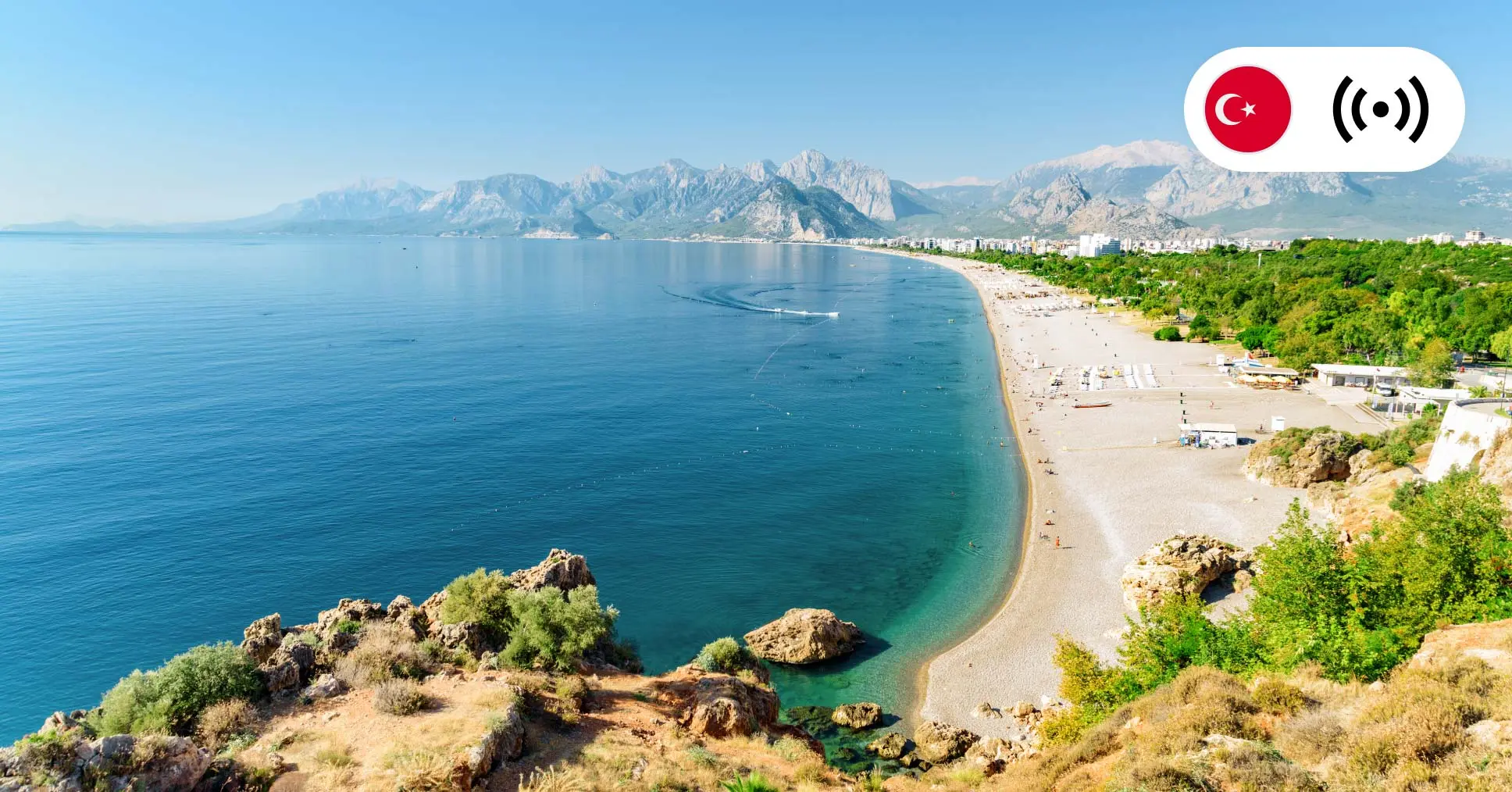
Antalya is a great choice if you want to experience Mediterranean weather, visit beaches, and live in an international community. It provides a slower coastal lifestyle supported by solid city infrastructure.
Izmir offers a relaxed Aegean city feel and easy access to nearby coastal towns, providing a good balance between urban amenities and affordability.
Bodrum features stunning sea views and a stylish lifestyle, though it is highly seasonal. Many local businesses close and the social scene quietens down significantly outside of the summer months (May-October), which can make it feel a bit isolated in the winter.
Fethiye is perfect for a quieter pace and spending time in nature. It offers easy access to beaches and mountain scenery, making it a great base for sailing and hiking.
It’s also worth checking whether Turkey is safe for Americans if you’re traveling from the US and want a clearer sense of local safety, culture, and travel conditions.
Internet and connectivity for digital nomads in Turkey
The internet in Turkey is generally reliable for remote work in major cities and tourist areas, with fiber broadband widely available in apartments and solid Wi-Fi in most coworking spaces and cafés. For mobile connectivity, you can pick up a SIM card for Turkey from local carriers for affordable data, rent a pocket Wi-Fi for Turkey if you prefer a dedicated hotspot, or stick with roaming in Turkey through your home provider if you only need short-term coverage. An eSIM is another popular option, but a few things are worth knowing before you rely on one.
Since July 2025, Turkey’s telecoms regulator (BTK) has blocked access to most major international eSIM providers from inside the country. The good news is that plans bought and installed before you arrive will work normally. To avoid any issues, you can download the Saily app and set up a Saily eSIM for Turkey before you travel so you have mobile data as soon as you land.
One other thing to keep in mind if you’re planning a longer stay — Turkey requires foreign phones to be IMEI registered if you use a local Turkish SIM or eSIM for more than 120 days. After that grace period, unregistered devices get blocked on Turkish networks, and the registration fee is currently TRY 57,241 (over US$1,200 at recent exchange rates). International travel eSIMs like Saily connect as roaming devices rather than local subscribers, so they’re generally exempt from this requirement — which is one reason many longer-stay nomads prefer them.